Fedora Project Community Corner @ DevConf.IN 2026 - Day One
Amidst travel hiccups, rapid setup, delayed mealing and awkward difficulties, the Fedora Project Community Corner in DevConf.IN 2026, hosted by Matthew, Samyak, Shounak, Yashwanth and me, engaged with hundreds of conference attendees in conversations, onboarding, competition and activities.
As the event owner for the Fedora Project’s community presence during the DevConf.IN 2026 conference, I had to ensure that I made it to the event venue as early as possible. The first day began with me getting ready by 0930am Indian Standard Time since I had returned from meeting the likes of Samyak Jain, Matthew Miller and Karen Miller late the day before. I had to put a pin on my plans to check the inventory of the swag packs that I had delivered at Shounak Dey’s house, as it was quite the struggle to get us Uber rides to the MIT World Peace University campus, Kothrud. While checking with Yashwanth Rathakrishnan, I also ensured that I packed the essential tooling that might come in handy while establishing and tearing down our booth at the DevConf.IN venue.
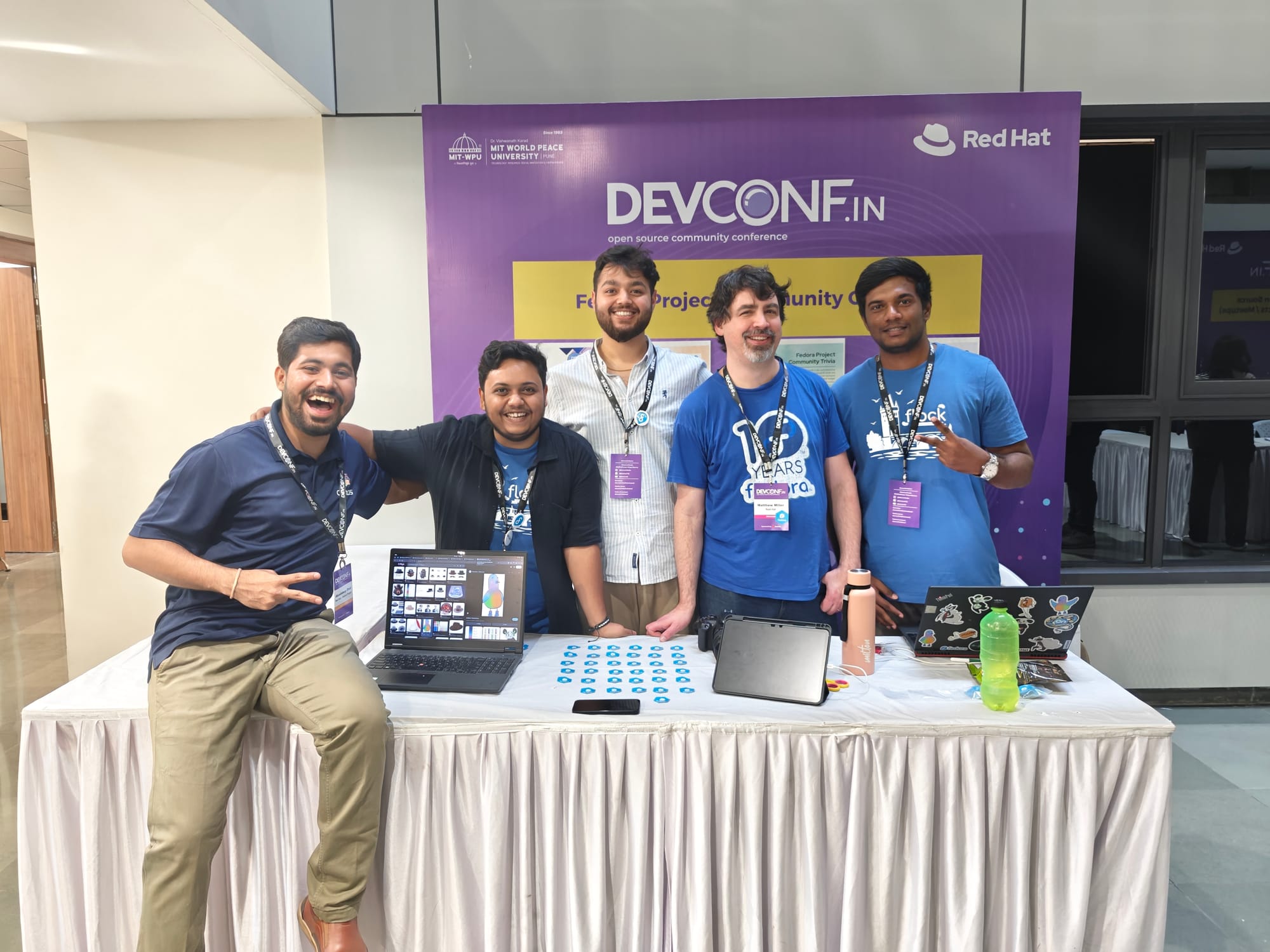
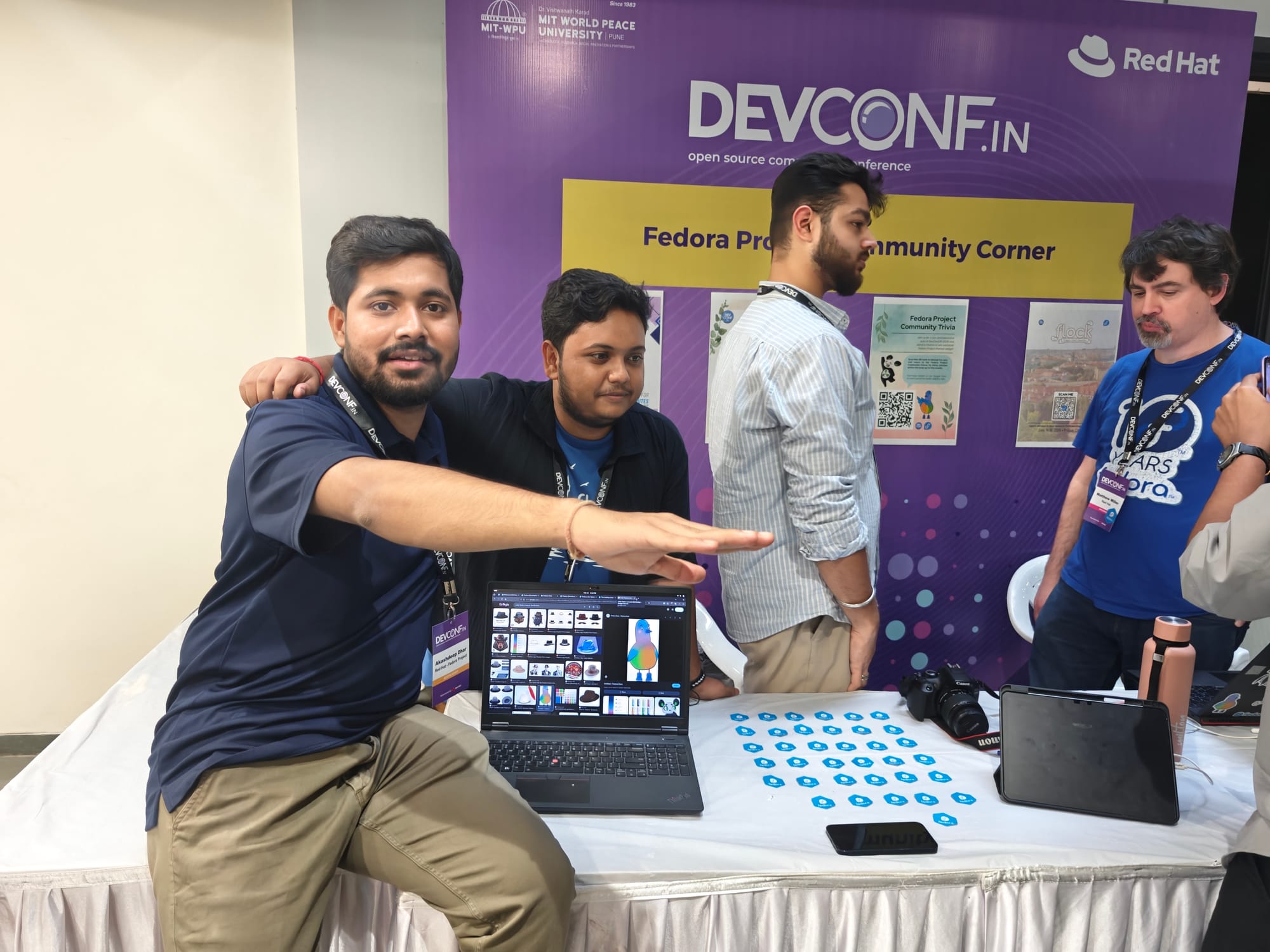
Collection A (Akashdeep Dhar, CC BY-SA 4.0)
After a couple of Uber cab cancellations, Shounak and I were finally on our way from Chandan Nagar to Kothrud. We seemed to have greatly underestimated the time it would take for us to get there, as not only was it thirty kilometres away from us, but the morning office-going traffic was also at its peak. We projected that it would take us around an hour to get there, but since the booth activities were to begin from 1100am Indian Standard Time onwards, we had ample time in our hands. I checked in with Yashwanth and Samyak on our organiser chatroom, who had reached there by around 1000am Indian Standard Time. They had joined the queue to pick up their badges and swag packs from the organiser’s desk, and also went ahead to visit where our Fedora Project Community Corner was located.
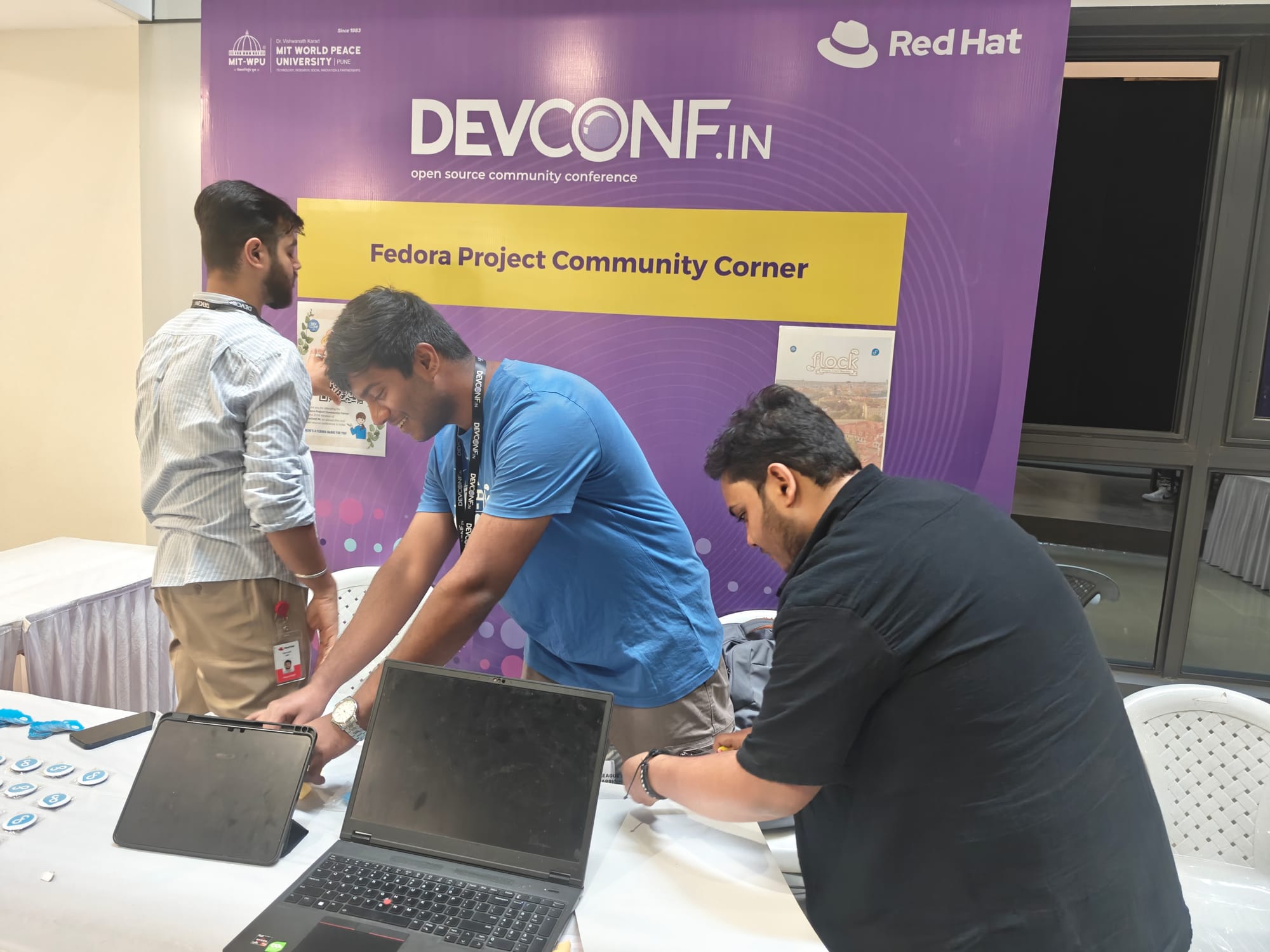
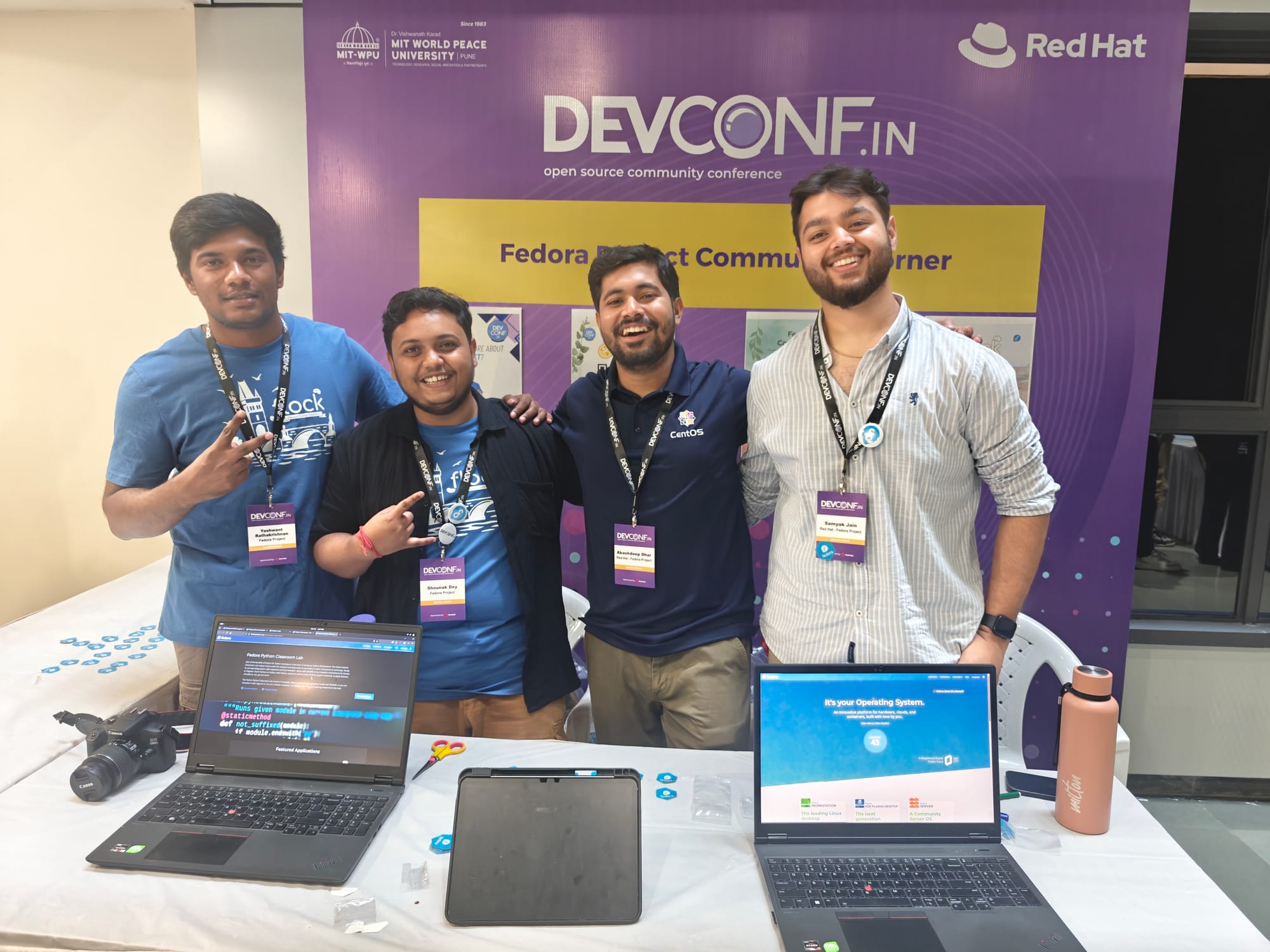
Collection B (Akashdeep Dhar, CC BY-SA 4.0)
To both Shounak’s and my chagrin, we figured out a little too late that the venue had been moved to the newly constructed Vyas Building of the MIT World Peace University campus. We realised it after our (rather friendly) Uber driver dropped us off, so the two of us had to walk around a kilometre hauling the heavy swag boxes and booth equipment. I did connect with Yashwanth and Samyak so that they could help carry those over from the entrance, but there must have been a disconnect, as Shounak and I had to sweat our way into the Vyas Building anyway. After passing a security check and a flight of wide stairs, our relief came in the form of one patient, Avadhoot Dhere, whom we met at the building’s entrance, who helped us carry our load to the Fedora Project Community Corner location.
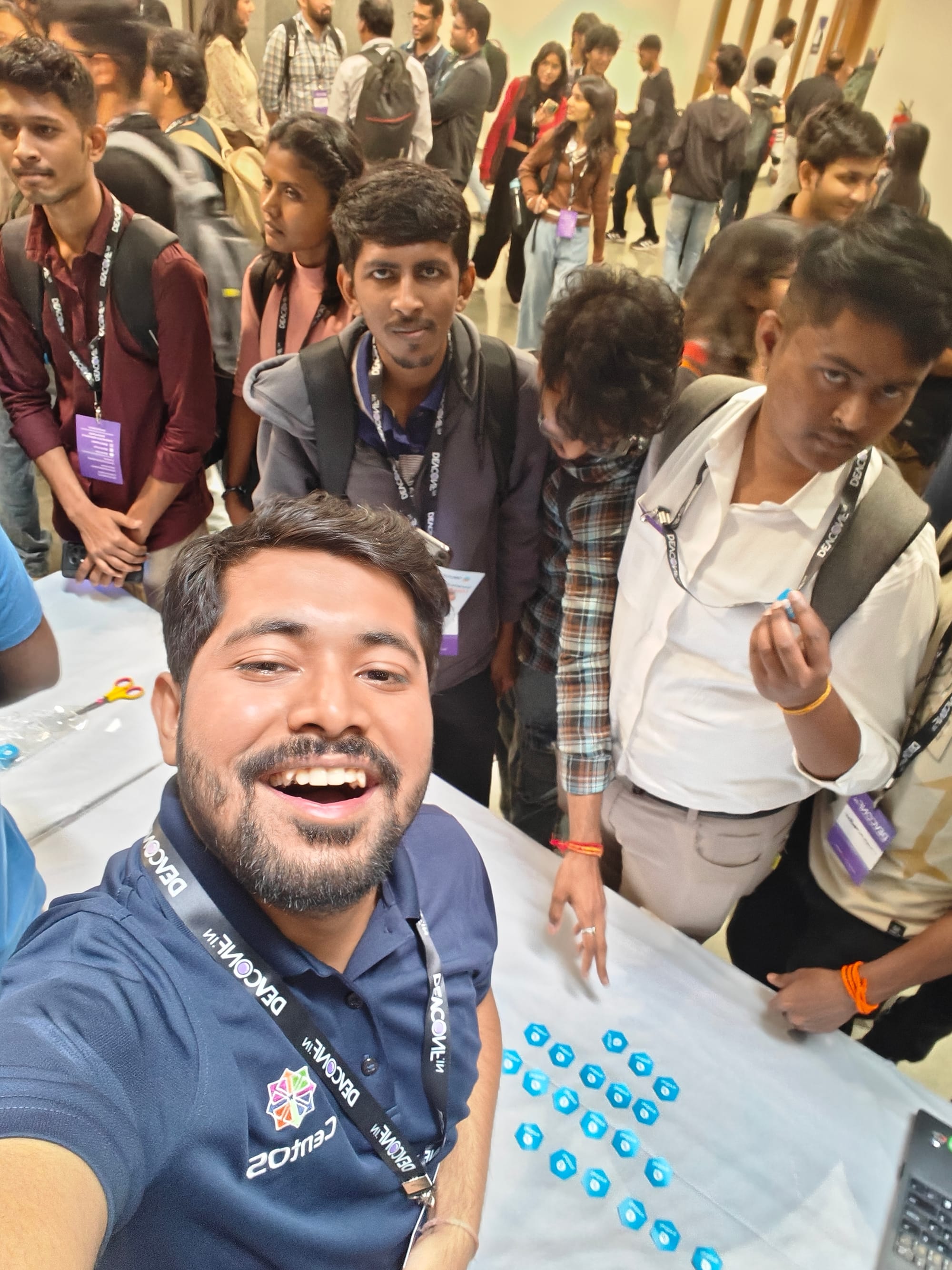
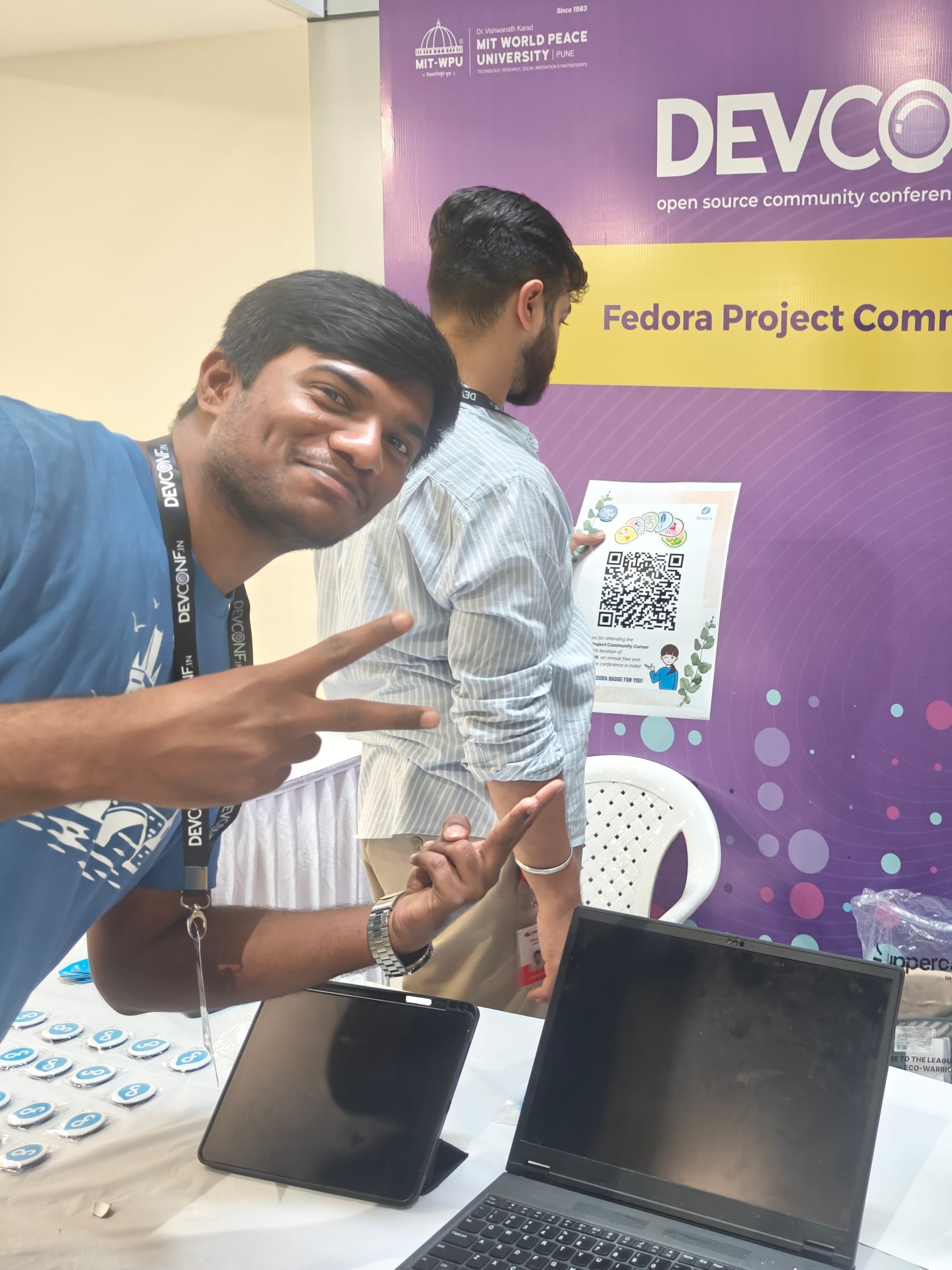
Collection C (Akashdeep Dhar, CC BY-SA 4.0)
At around 1030am Indian Standard Time, we had about thirty minutes to get our community booth set up with exhibits and swag packs. I delivered a quick briefing to our on-site Fedora Project Indian Crew on what was expected of them and how they had to abide by the DevConf.IN Code of Conduct, when to take breaks after duly informing about the same, and how judicious they have to be regarding the swag distribution. We started drawing quite a huge crowd of early visitors to the booth while we were busy setting up the community booth, a bunch of whom confused our location with the registration desk. Huge kudos to Rajan Shah, who helped us secure a strategic location to allow for most (if not all) community conversations to come to us first before they seeped into other booths.
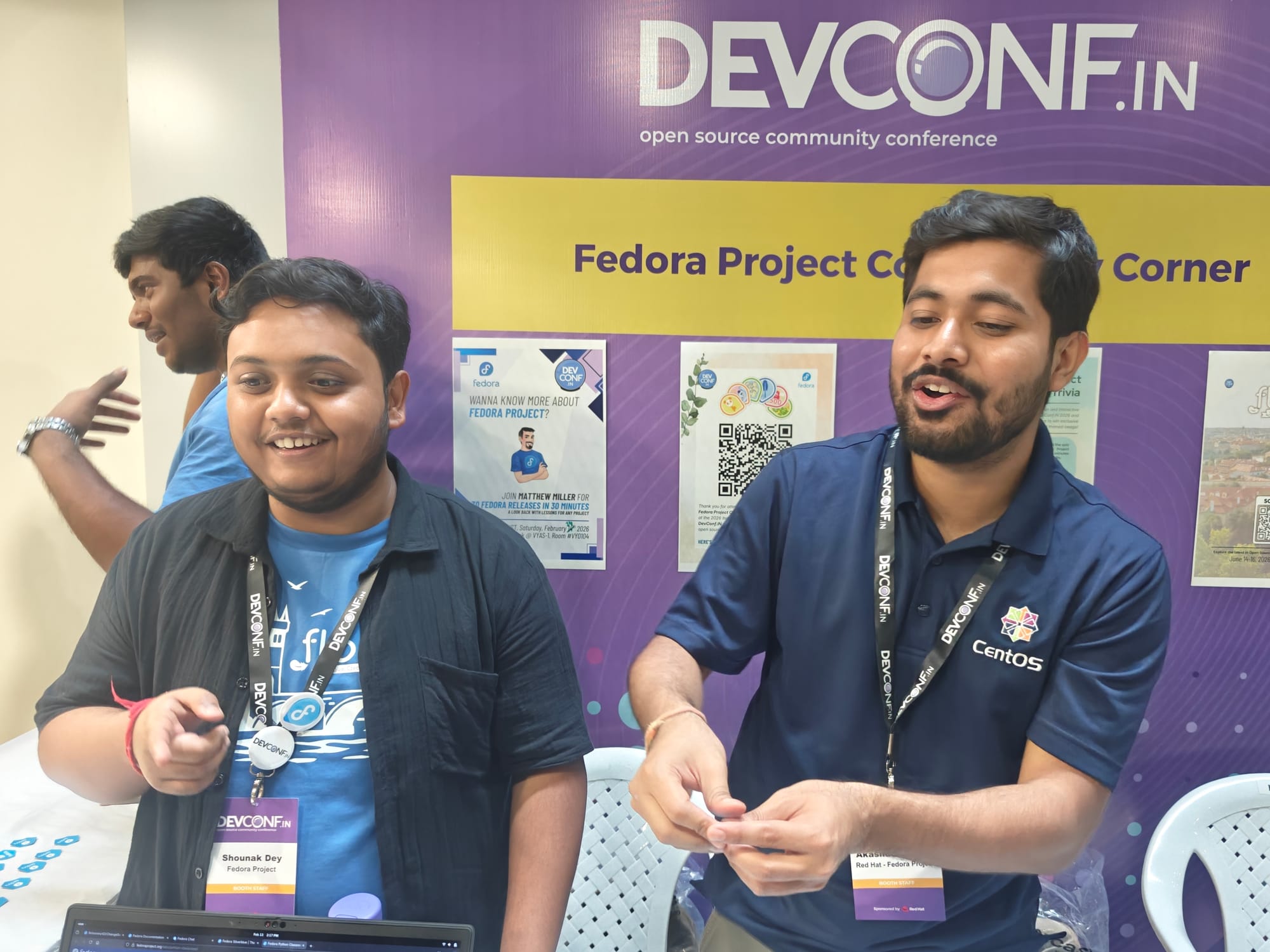
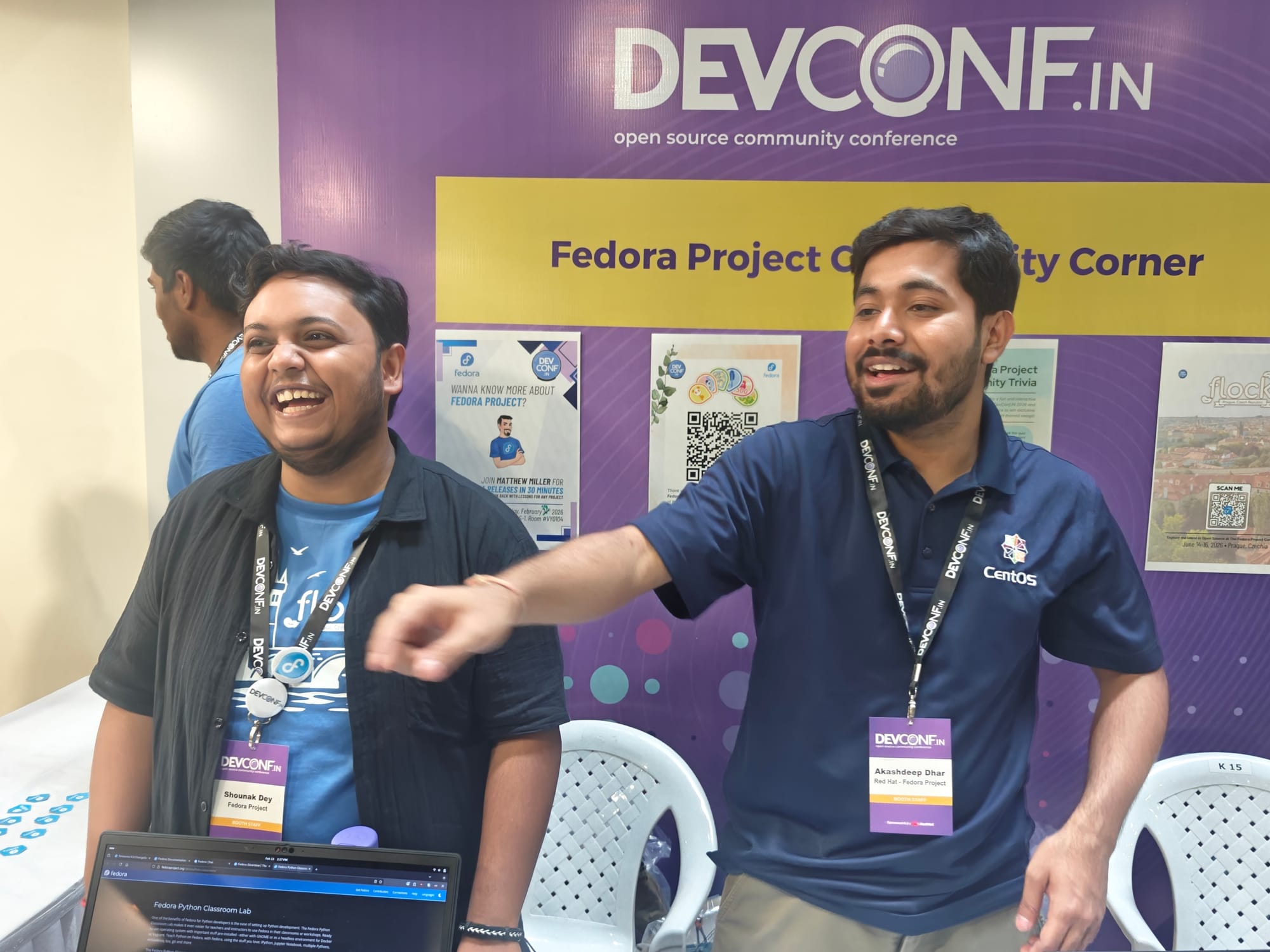
Collection D (Akashdeep Dhar, CC BY-SA 4.0)
While Samyak and Shounak got busy setting up the A3-sized posters that I had previously designed, Yashwanth and I worked on organising the swag stickers and swag magnets on our booth desk. I briefly paused to take in just how amazing a task the DevConf.IN 2026 organising committee did with arranging the booth backdrops and positioning the two desks at a right angle for us. With Samyak’s handspan calculations and Shounak’s accurate pasting, we soon had our four posters on topics like Matthew’s presentation, Flock To Fedora 2026, DevConf.IN 2026’s Fedora Badge and Fedora Project Community Trivia, ready to go. Since we had visitors lining up already before the scheduled beginning, we had to double-time addressing the people and setting up our Fedora Linux-powered laptops.
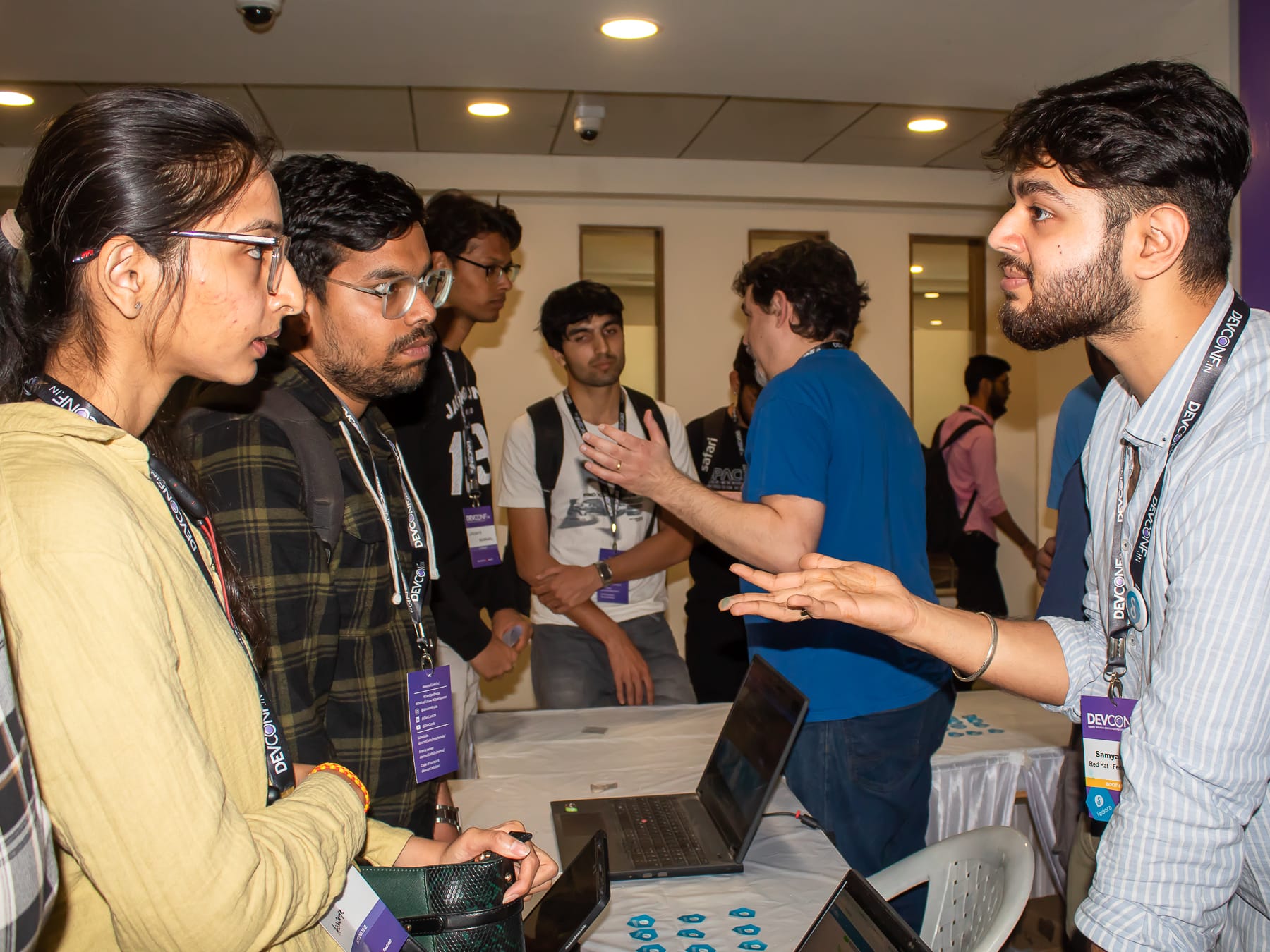
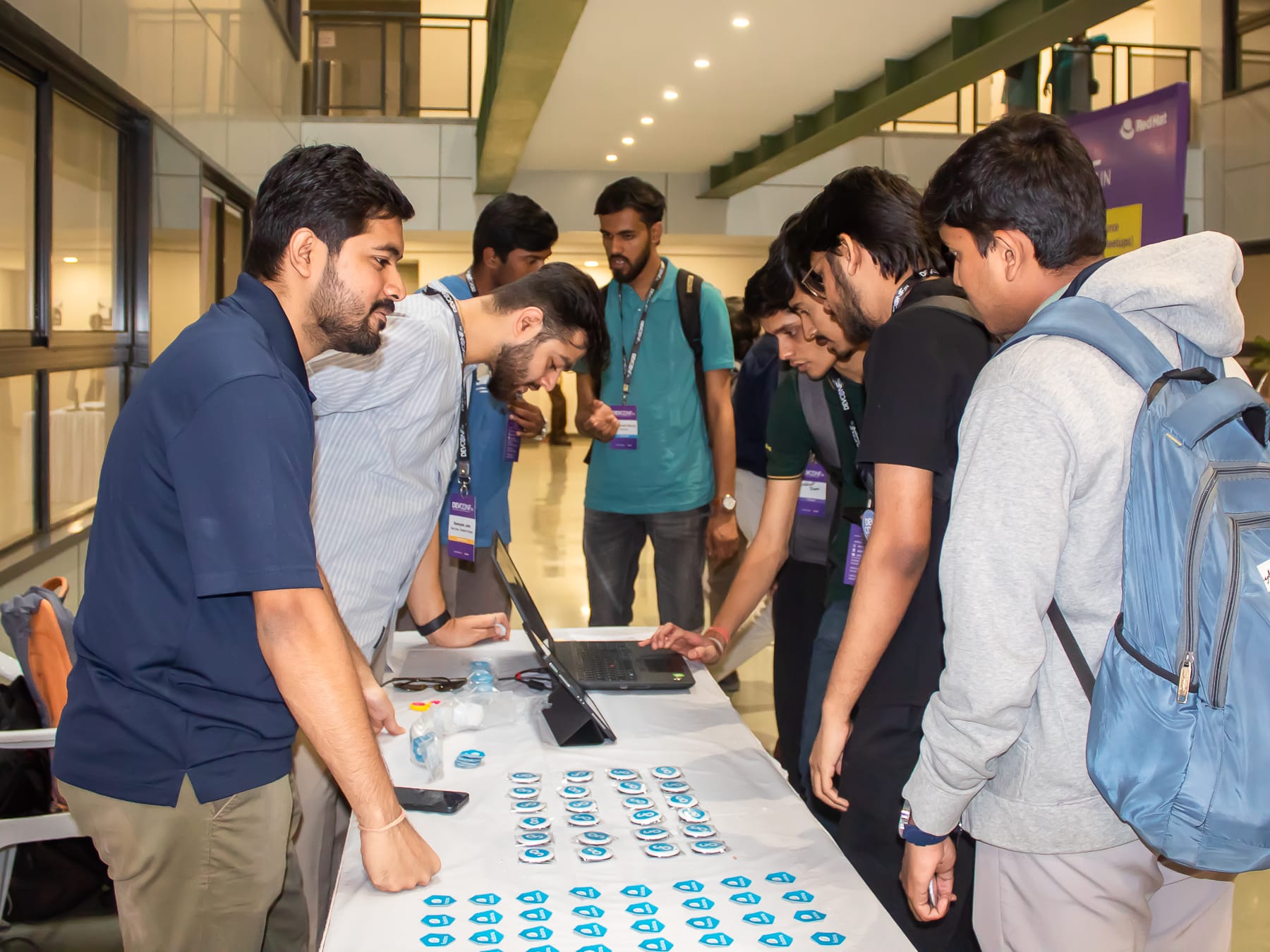
Collection E (Shounak Dey, CC BY-SA 4.0)
By around 1100am Indian Standard Time, we had already addressed approx 200 visitors at the booth, so you could imagine just how difficult the opening hours were for the on-site Fedora Project Indian Crew to handle that wave. Our economical yet outgoing approach towards handing out our limited swag packs allowed us to pace ourselves while dealing with a huge number of attendees. To add to that, our inclusive demeanour towards the visitors allowed them to bring their conversations and feedback about Fedora Linux and/or the Fedora Project to us. While the population numbers did not hold a candle against the likes that we usually get in places like FOSDEM, I extended those experiences to ensure that we did not stretch ourselves thin while answering questions and receiving feedback.
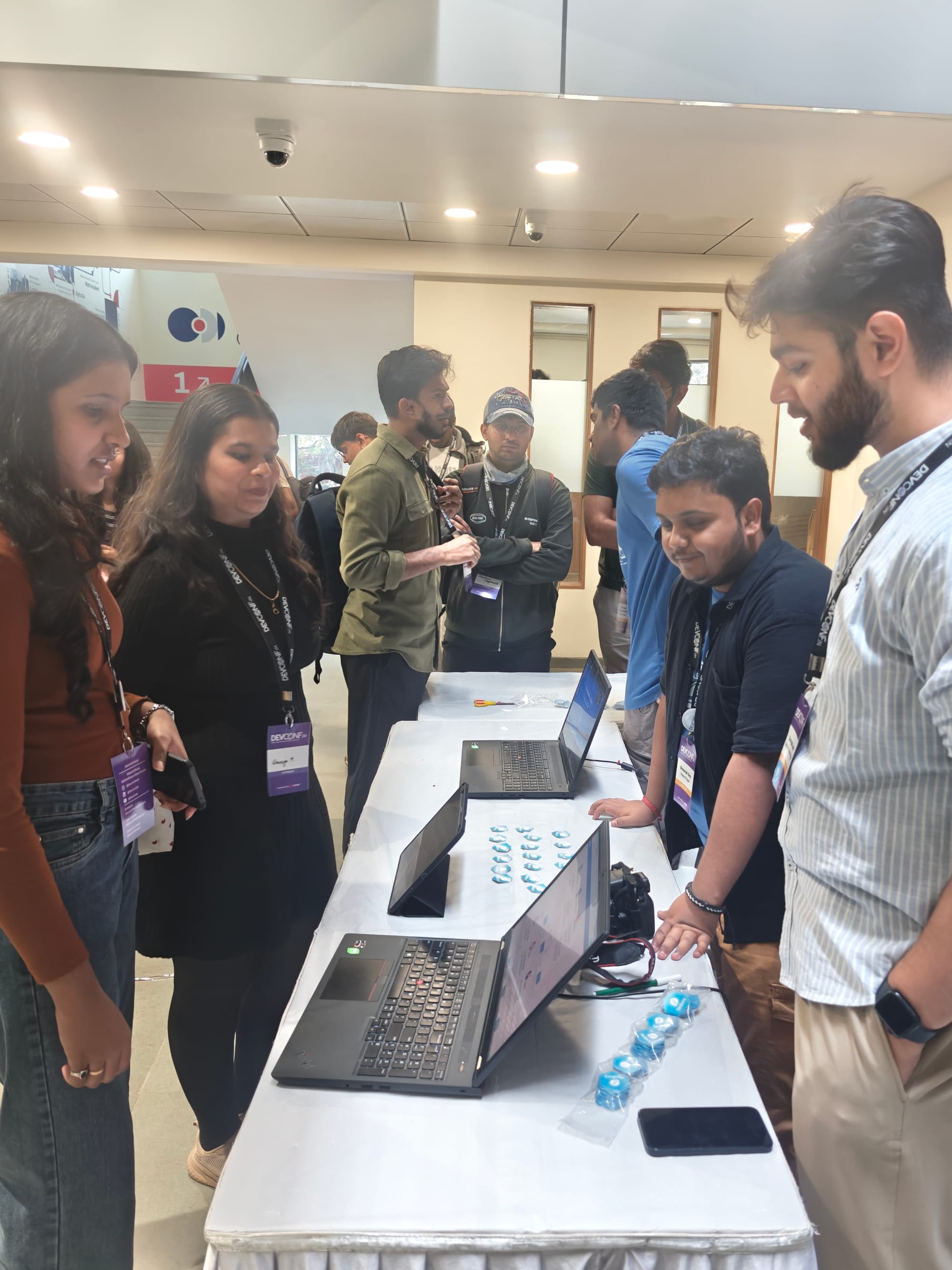
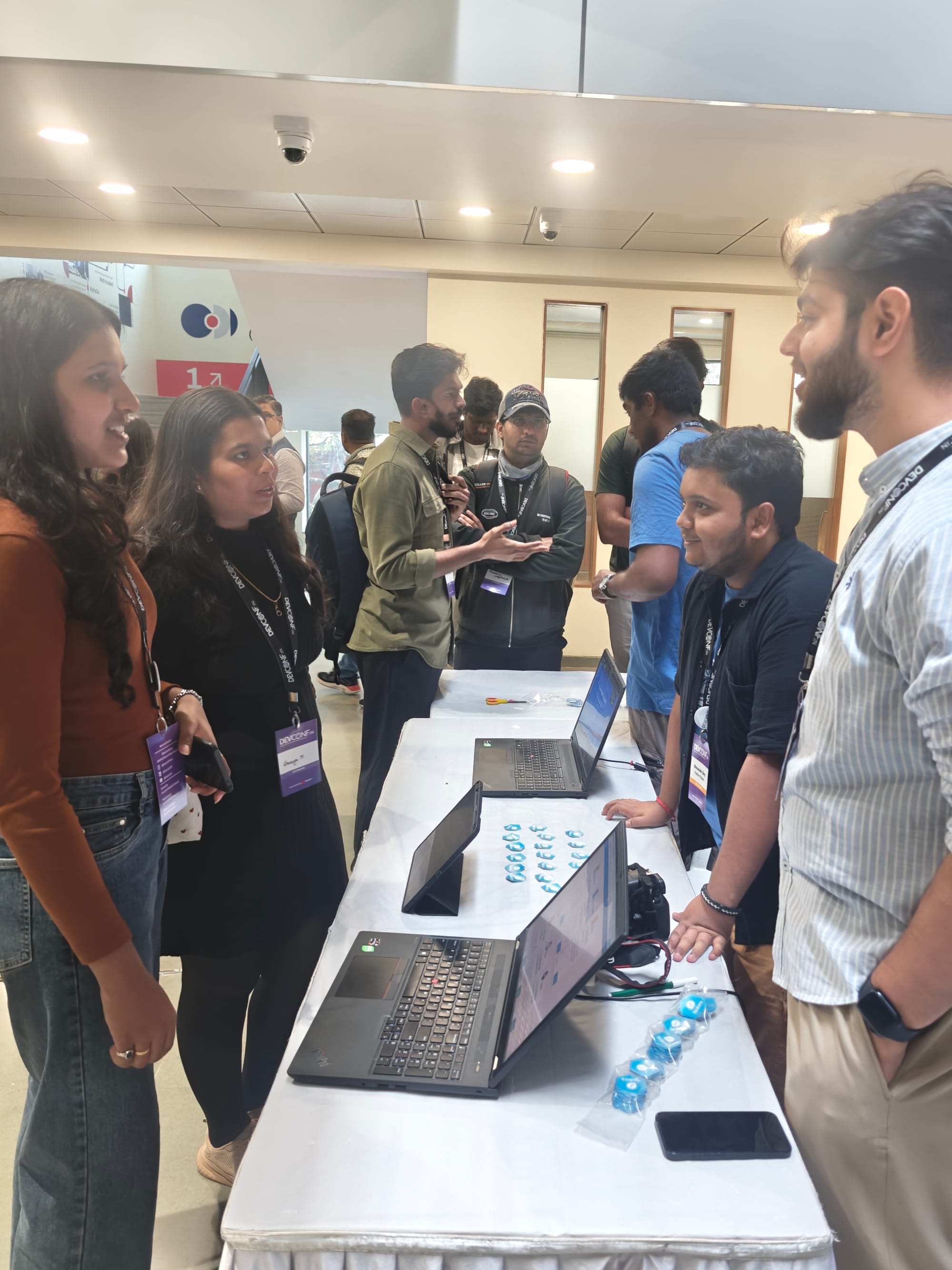
Collection F (Akashdeep Dhar, CC BY-SA 4.0)
We were also visited by Dorka Volavkova, who checked in with me about the situation regarding the availability of swag packs at our booth. While I was initially dependent on folks portering in swag packs from various other events due to logistical difficulties, I soon realised that the plan was not reliable. I informed her about my decision to extend the Fedora Mindshare budget request by about USD 150 to ensure that I could produce the swag packs locally with Rajan’s and Devang Parikh’s assistance. This not only allowed for deterministic representation at DevConf.IN 2026, but the same resources could also be used for organising more such Fedora Project events around India or APAC. Dorka was happy to note that we followed an ideal process of getting swag packs for events from local vendors.
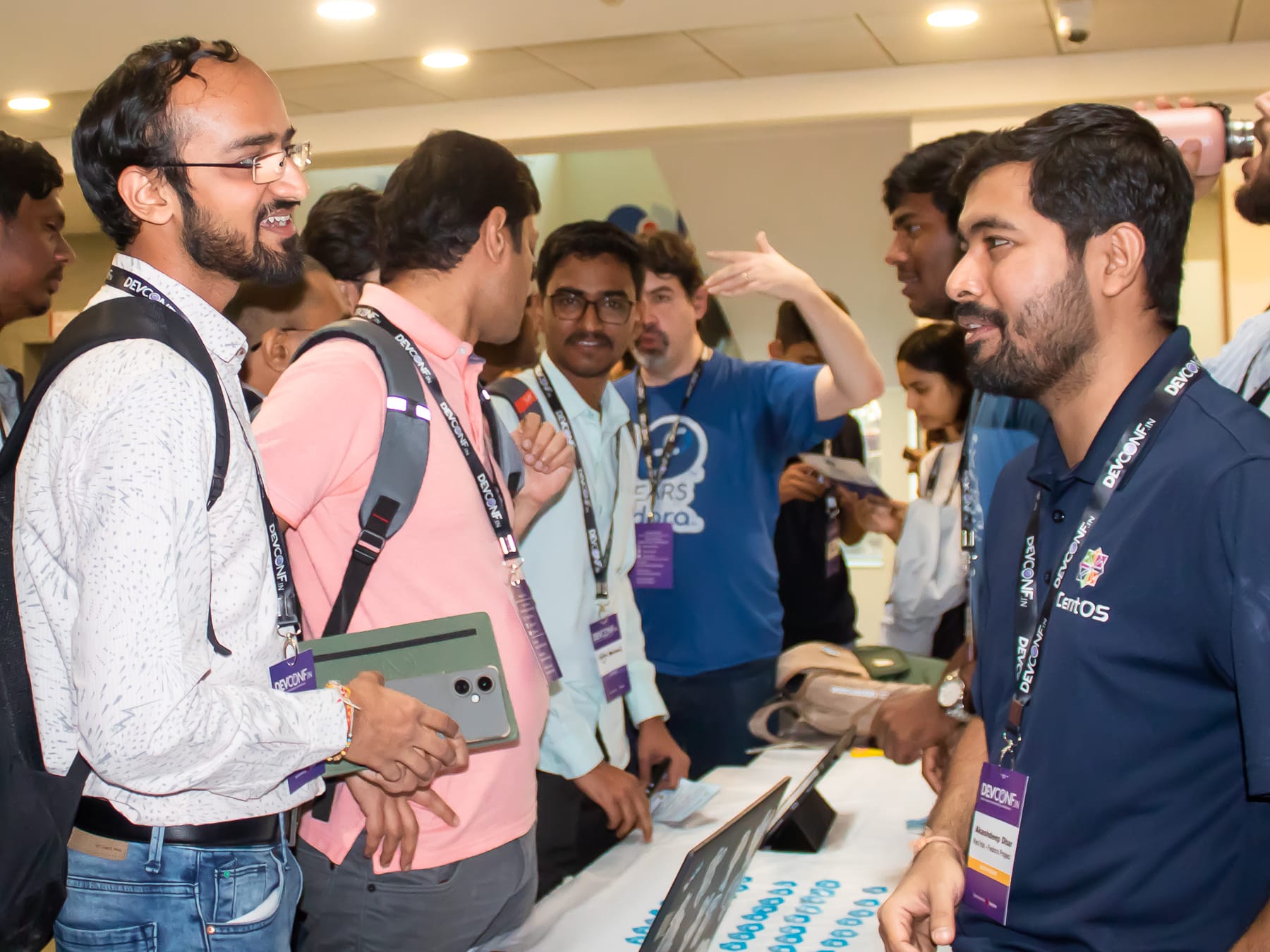
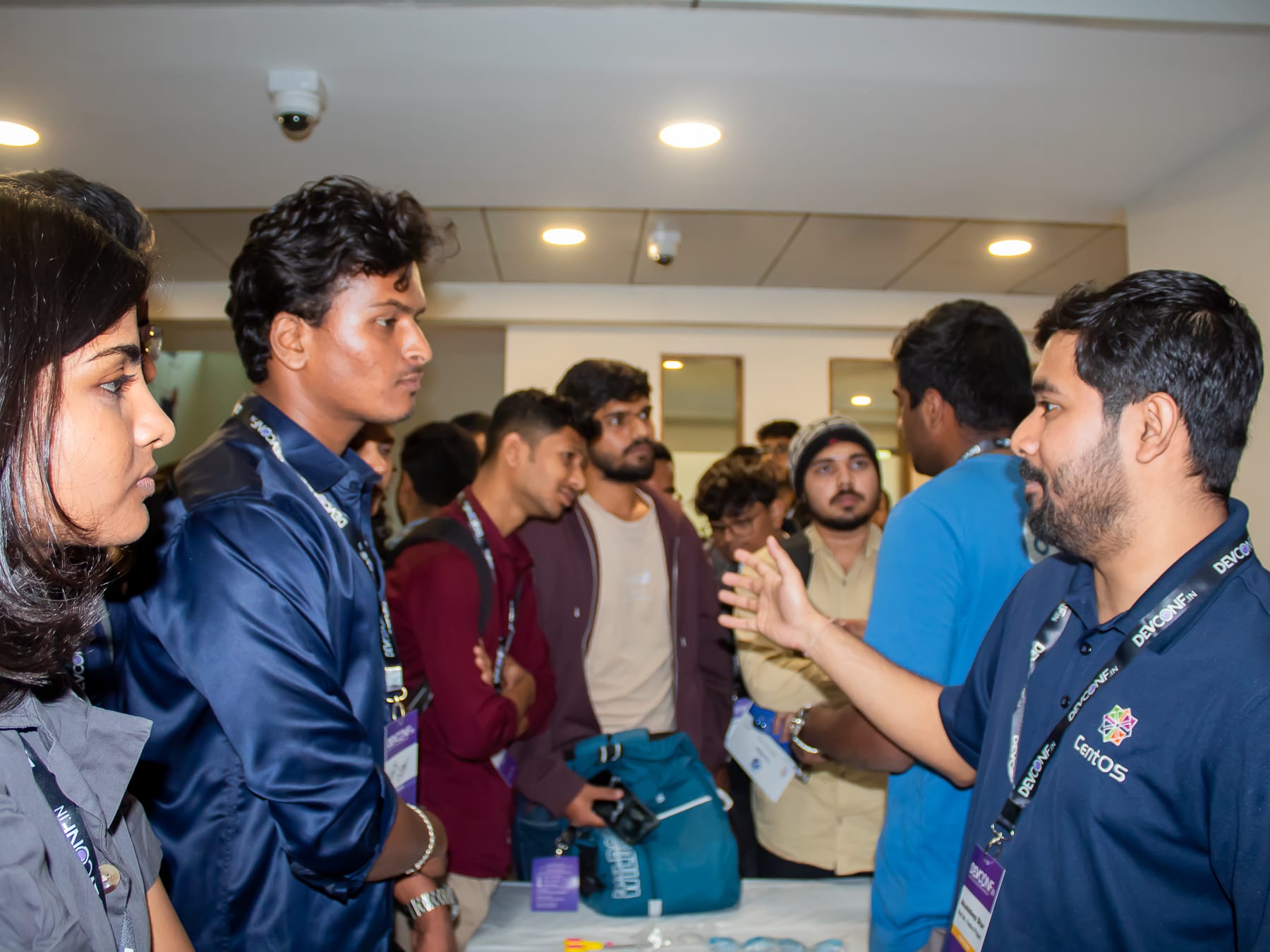
Collection G (Shounak Dey, CC BY-SA 4.0)
As the footfall slightly slowed down, Shounak and I took that opportunity to leave for the registration desk to pick up our badges and swag packs. It had literally escaped our minds since we were occupied with setting up the Fedora Project Community Corner, but we did manage to get our DevConf.IN-themed backpack and ID badges on time. We fielded various questions from visitors wanting to know about what the Fedora Project is, how Fedora Linux differs from other distributions, how Fedora Linux shapes the future of enterprise distributions, and what one can do to get started with contributing. Yashwanth suggested rewarding more interesting conversations with our limited-edition Fedora Project magnet-and-clip combo, and that helped us drive the course of our conversations and shape an open narrative.
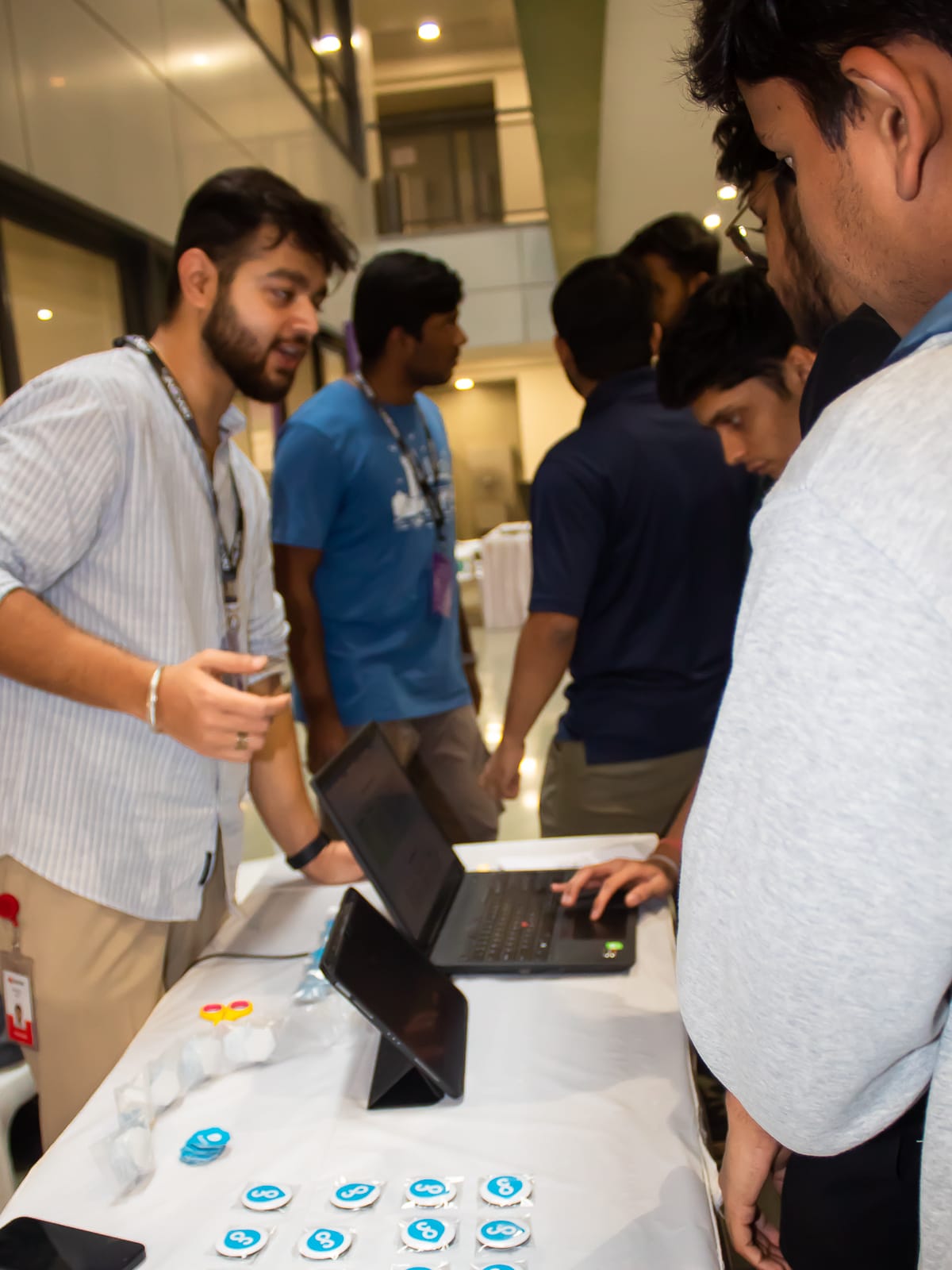
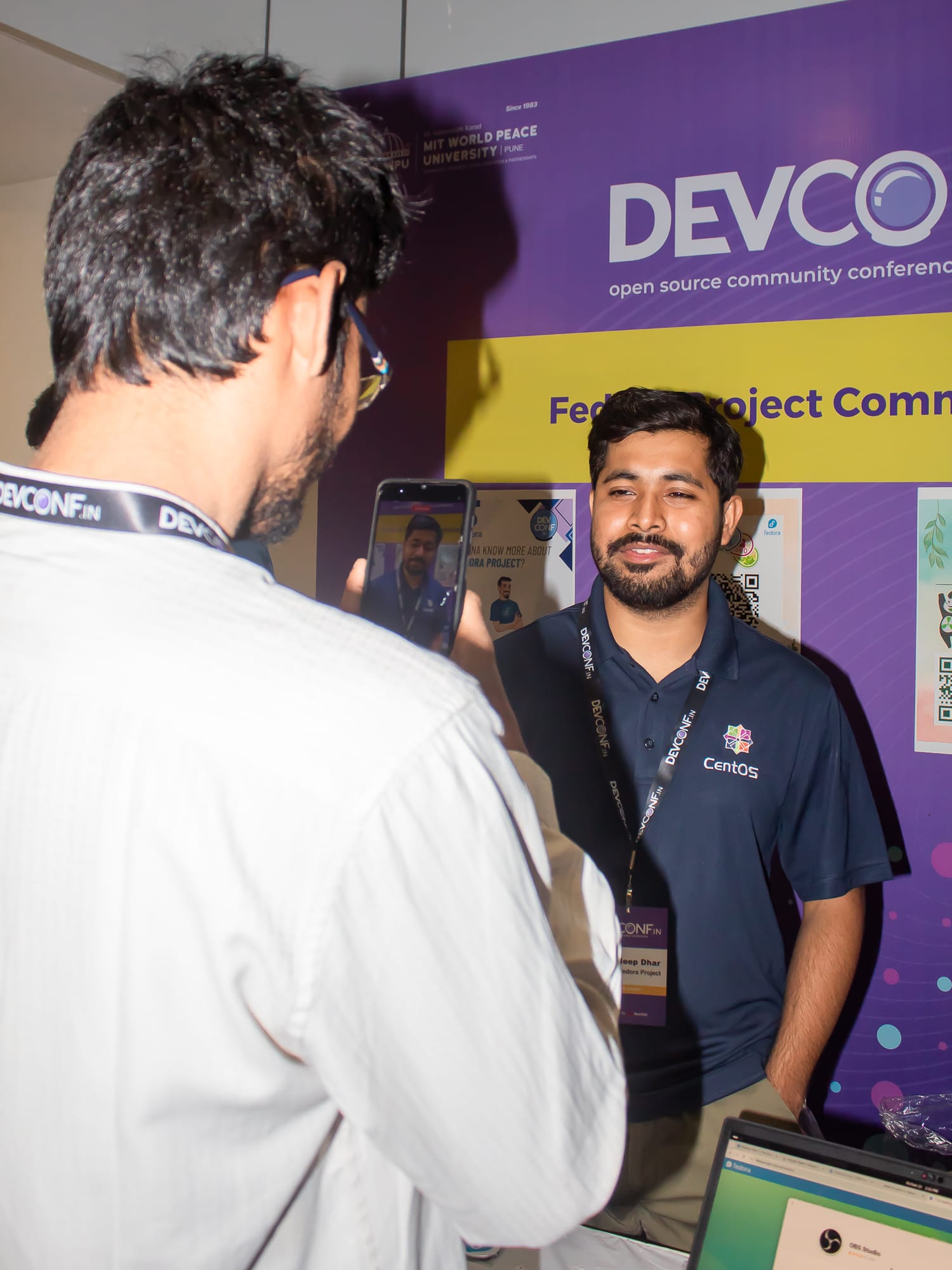
Collection H (Shounak Dey, CC BY-SA 4.0)
Matthew soon arrived at around 1200pm Indian Standard Time, and that not only gave us one more person to field interactions with, but the visitors could also avail themselves of the historical context about the Fedora Project that he could offer, having served in the Fedora Project Leader position for over a decade. This was also our opportunity to gather folks around us and promote his talk about “30/35 Fedora Linux Releases in 30/35 Minutes”, which was scheduled for the next day. The younger, college-going crowd looked up to us for working on free and open source software as our full-time employment and wanted to understand how they could begin doing the same. This was a great opportunity for us to showcase our onboarding pathways into the community through the Fedora Join SIG.
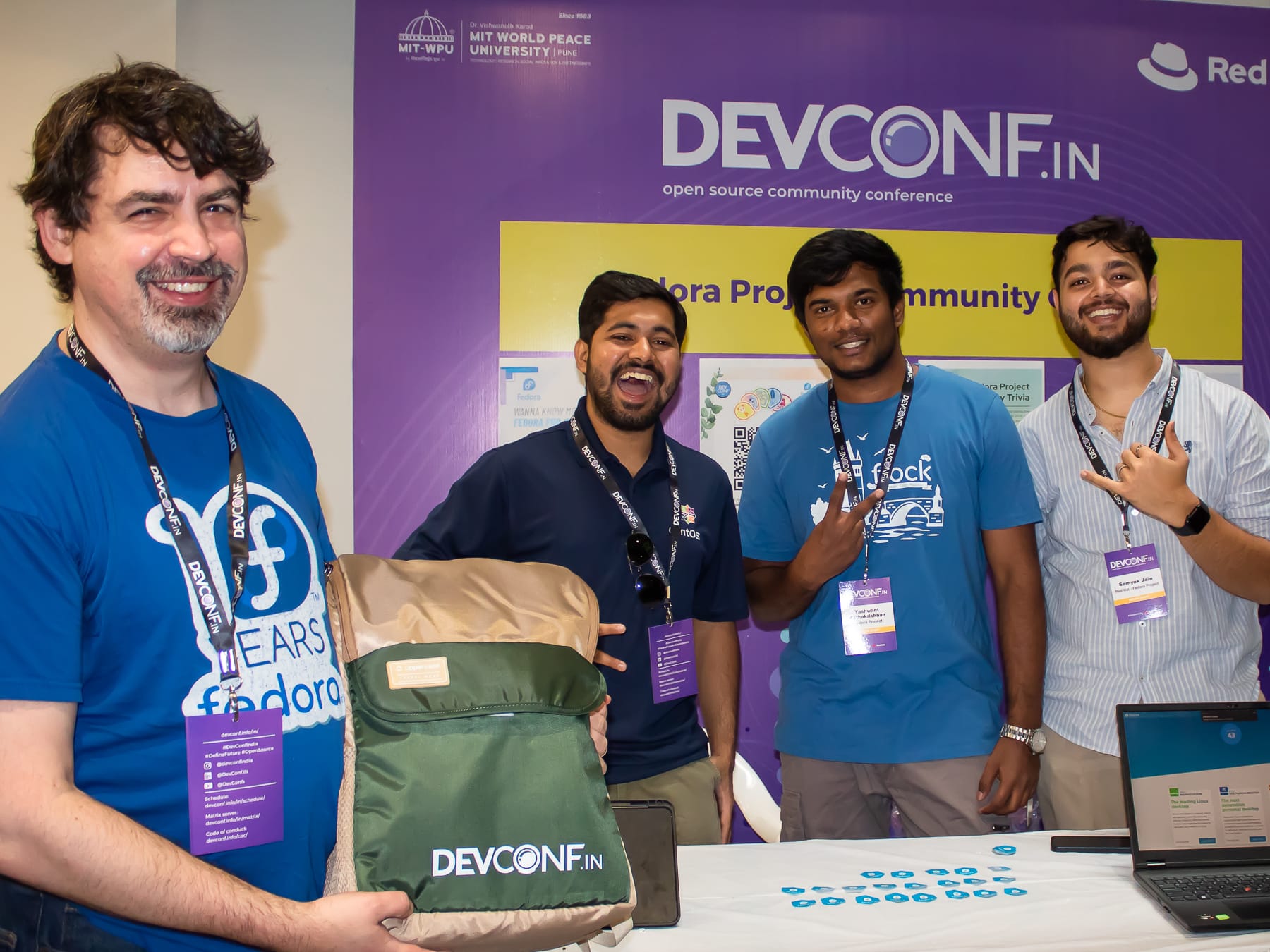
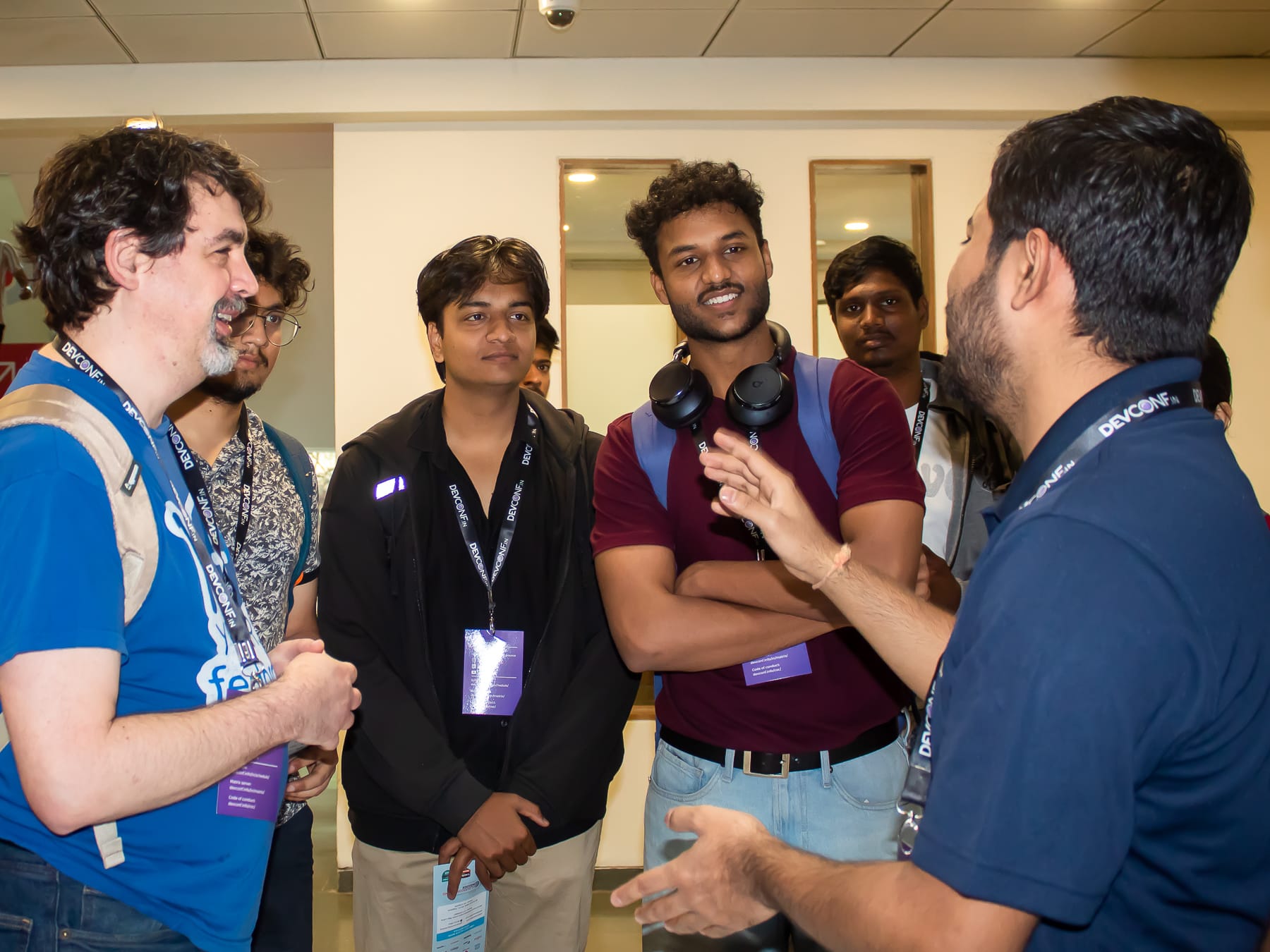
Collection I (Shounak Dey, CC BY-SA 4.0)
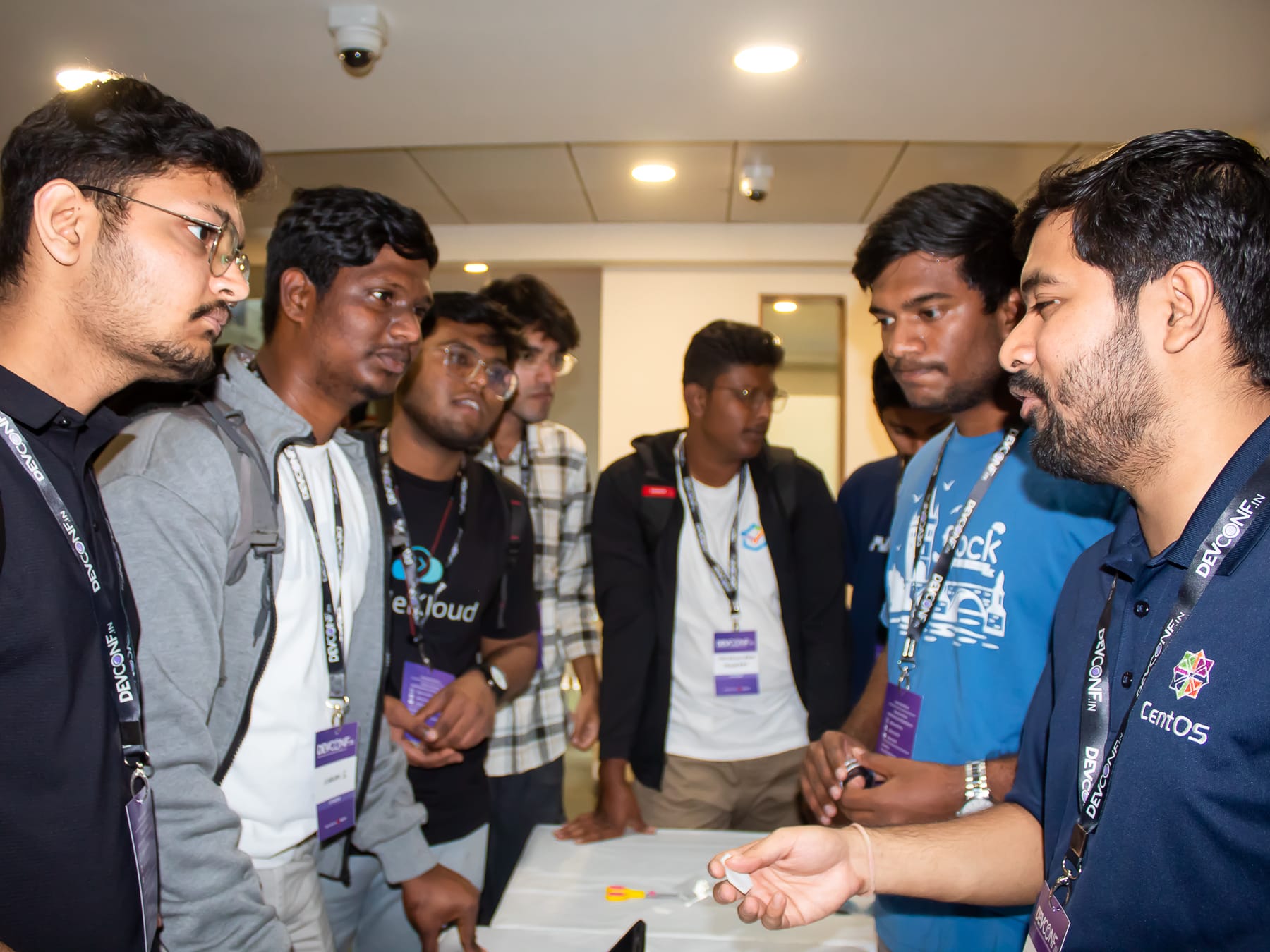
Among the curious questions that I fielded, a couple that I remember had to do with the incompatibility of Fedora Linux as a student base operating system for attempting CNCF certification examinations and the apparent lack of a long-term release in the Fedora Linux offerings. While I personally did not have any experience with those examinations, I elaborated on how Fedora Linux’s focus on innovation and the fast-moving release cycle could be something that could not be conveniently kept up with by the examination proctors. As for the question about the Fedora Linux long-term distribution release, I recommended that they use CentOS Stream and/or the Red Hat Enterprise Linux Developer Subscription for more serious workloads that require strict quality and uncompromising support.
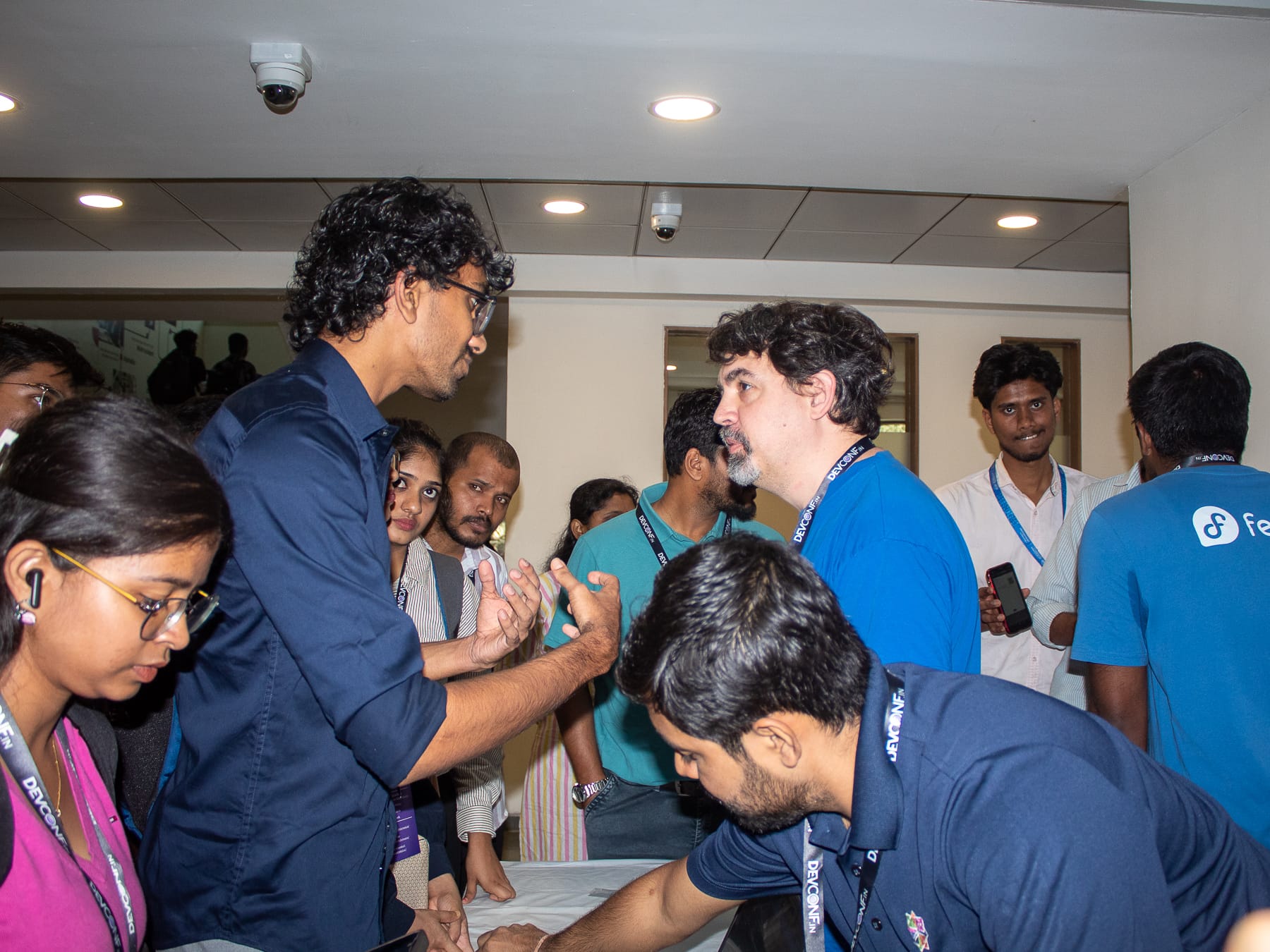
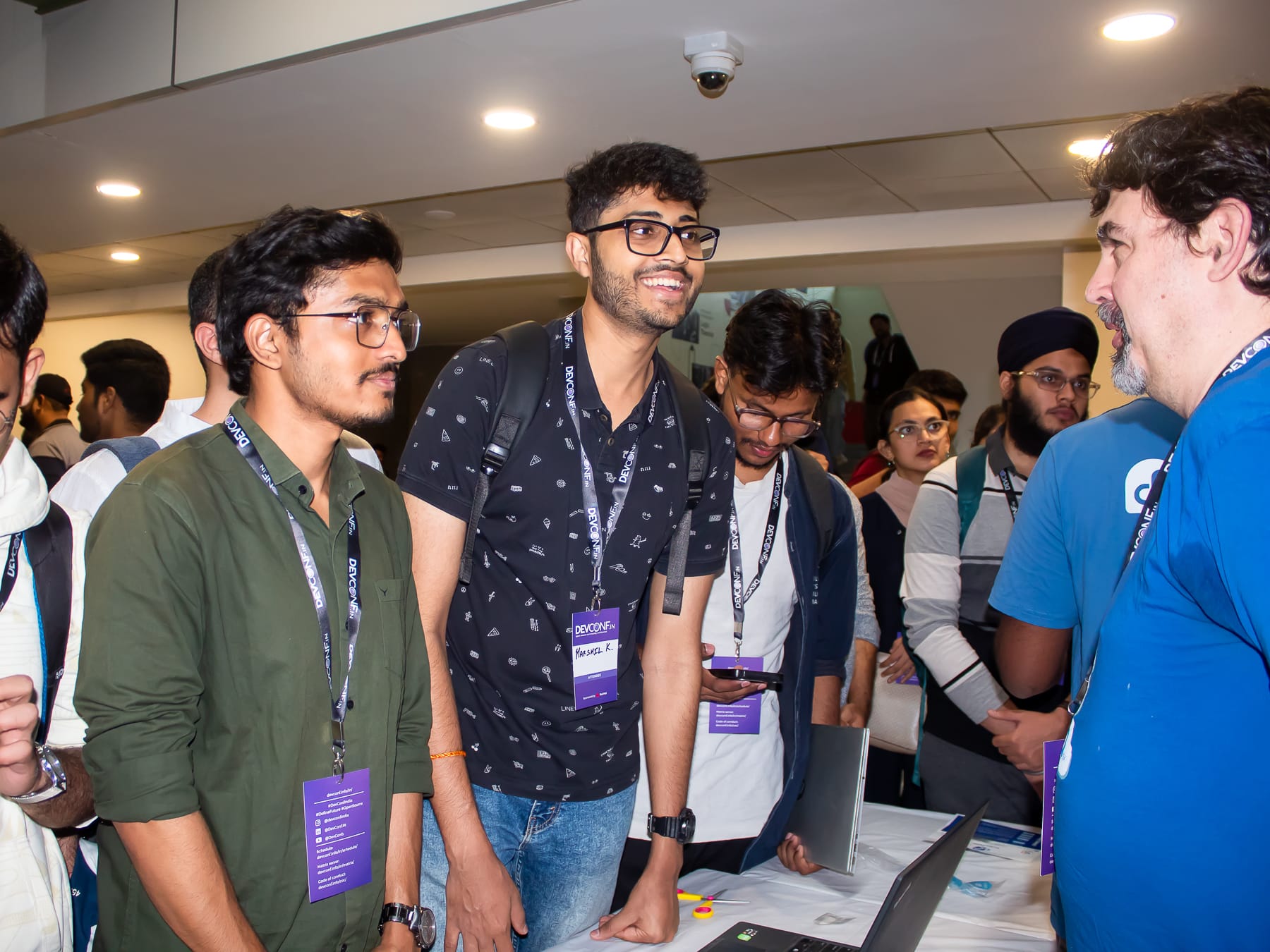
Collection J (Shounak Dey, CC BY-SA 4.0)
As I was wearing a CentOS Linux-themed tee, I was also able to steer discussions into explaining how the Fedora Project’s decisions around technologies such as the systemd movement, PipeWire inclusion, Wayland defaults, etc., were seen as controversial in the past but ended up becoming industry standards just a couple of years later. I wanted our conversations with the visitors to be a gateway through which they could start exploring the space of open source enterprise distributions and potentially begin contributing to the projects of their interest. Amidst our conversations, the visitors were drawn to the Fedora Project Community Trivia that Samyak helped craft questions for, and the fact that it had an exclusive Fedora Project-themed sipper as an award prize only helped us farm more engagement.
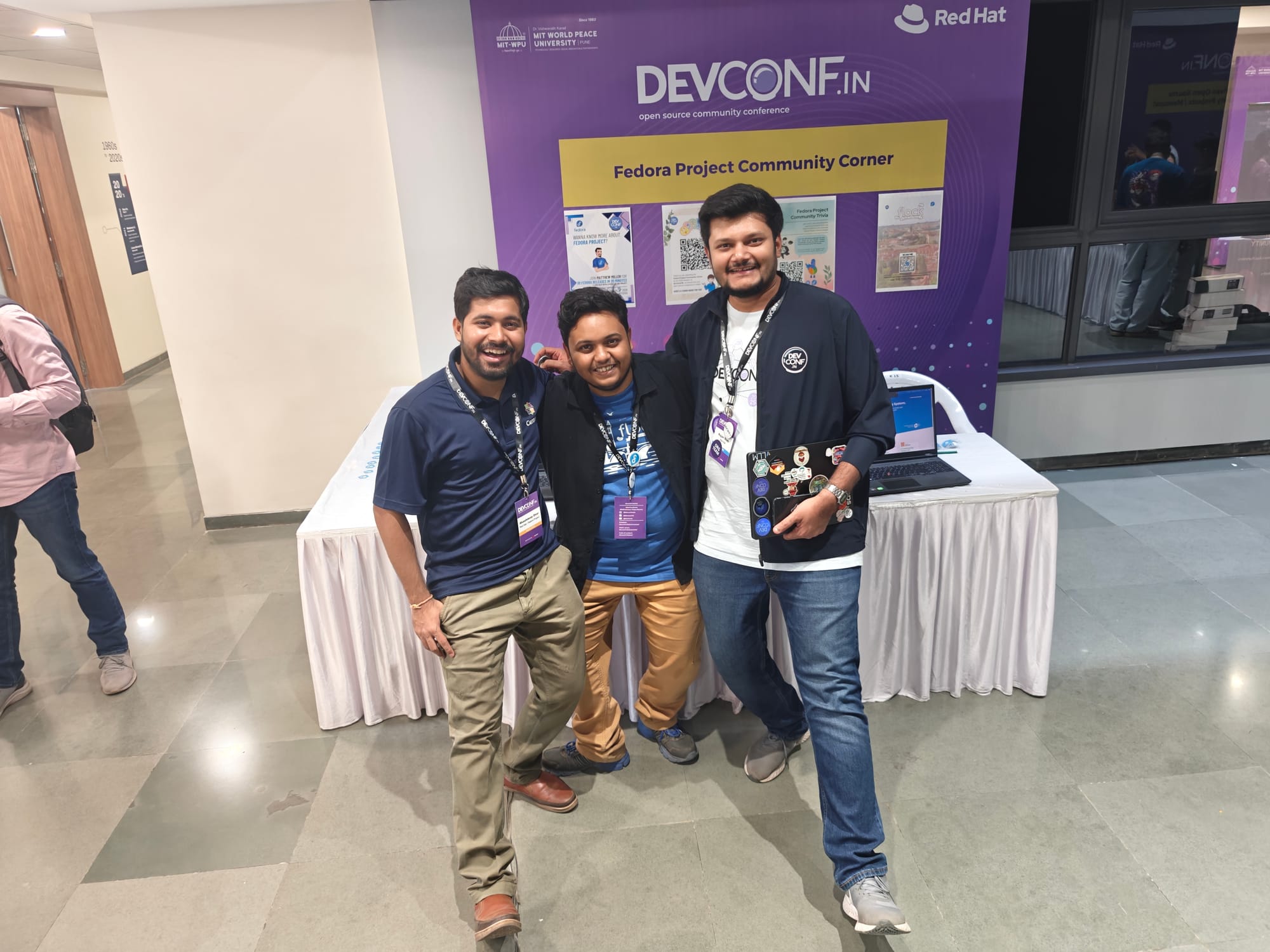
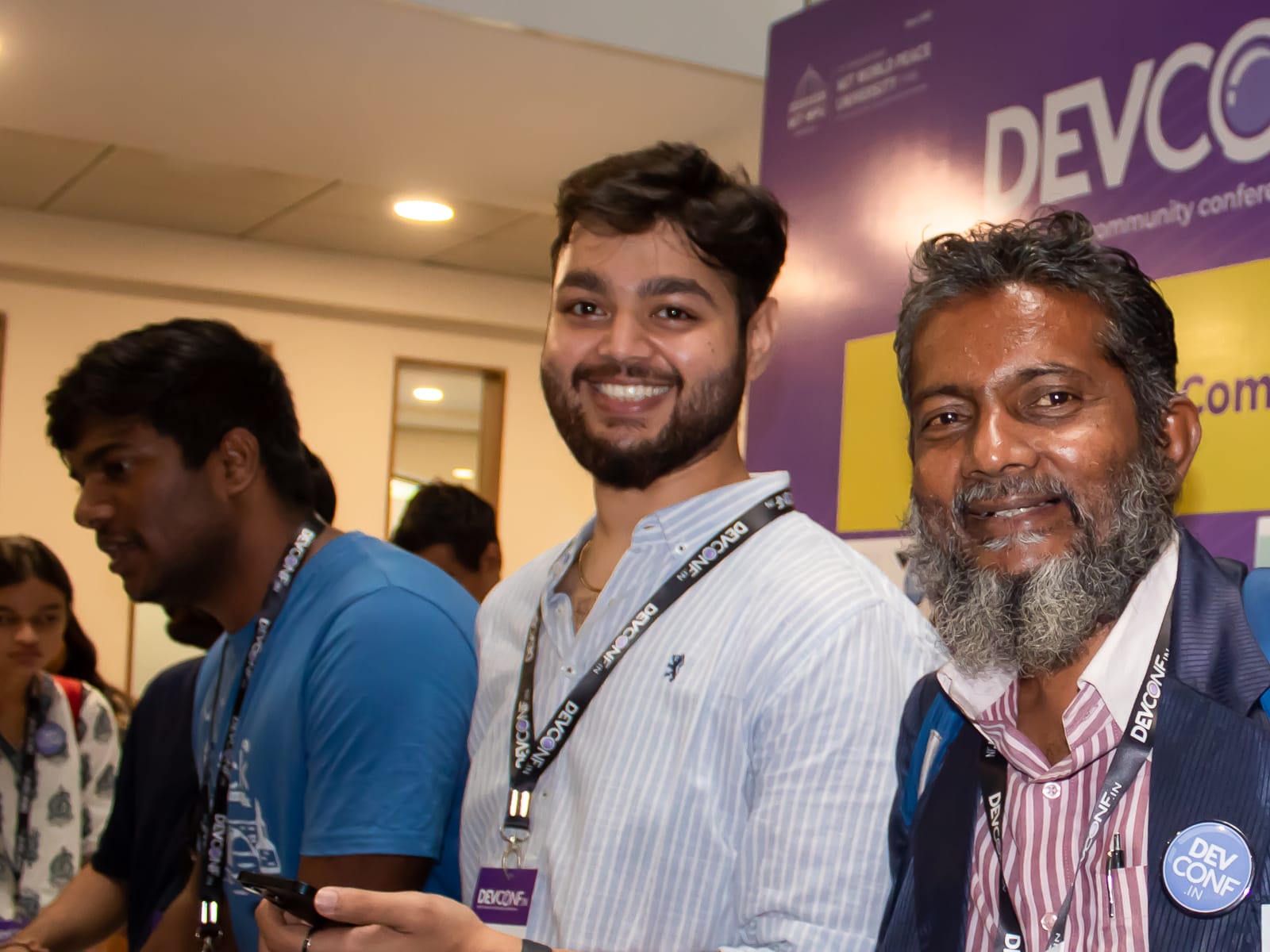
Collection K (Akashdeep Dhar and Shounak Dey, CC BY-SA 4.0)
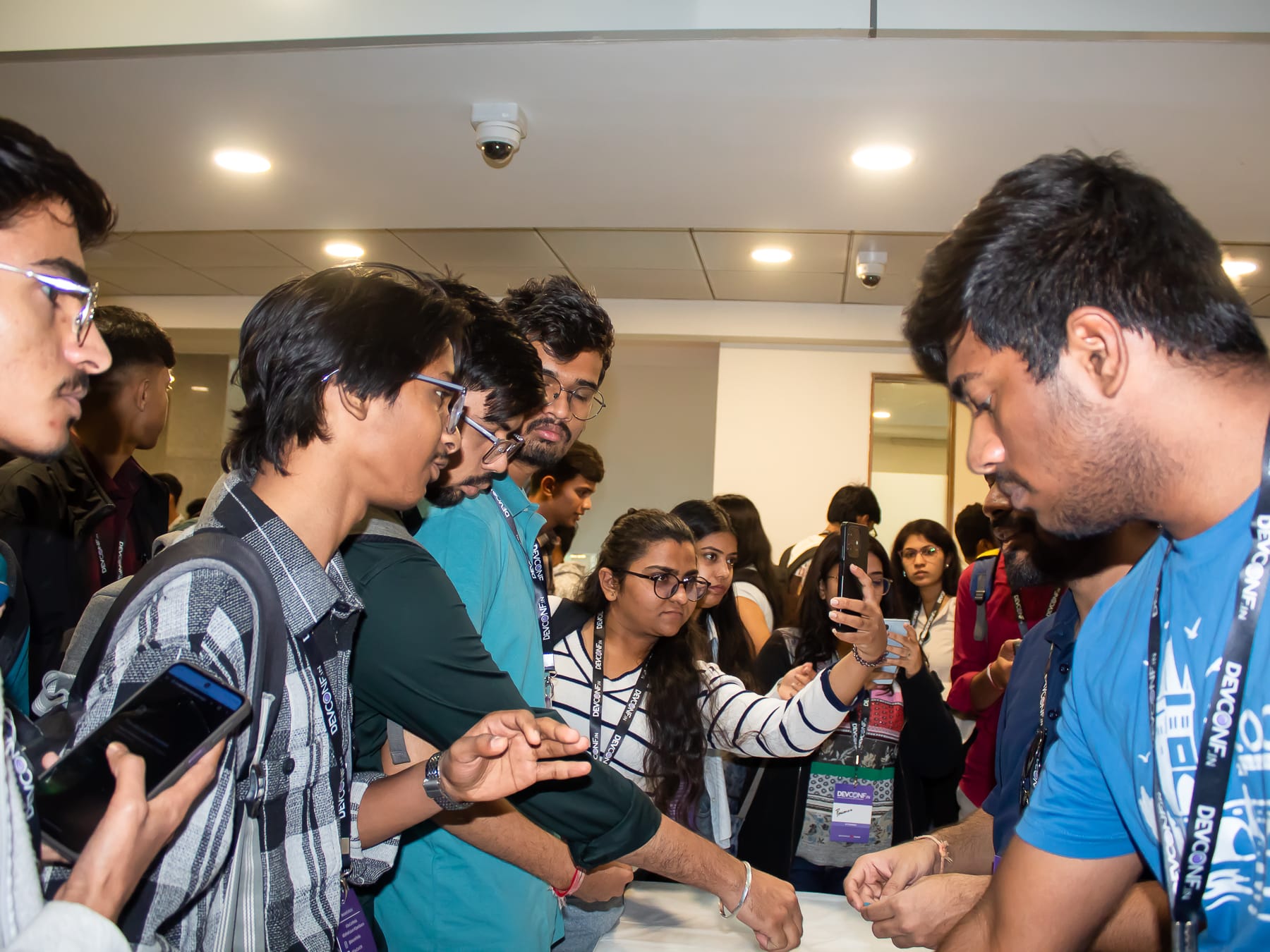
Shounak stayed busy photographing with his fancy Canon DSLR camera as we guided visitors to scan the QR code on our posters to do things like get themselves the associated Fedora Project event badge, learn more about the annual flagship contributor conference, Flock To Fedora 2026, and, of course, participate in the Fedora Project Community Trivia. A bunch of these visitors had experience using a GNU/Linux distribution, and with us sharing just how Fedora Linux allows them to build solutions for the consumers of today and tomorrow, with its packages being on the leading edge, they were eager to try it out on their personal devices. There were comparison conversations against the likes of Microsoft Windows and Apple macOS, too, on a more superficial level, among the younger folks there.
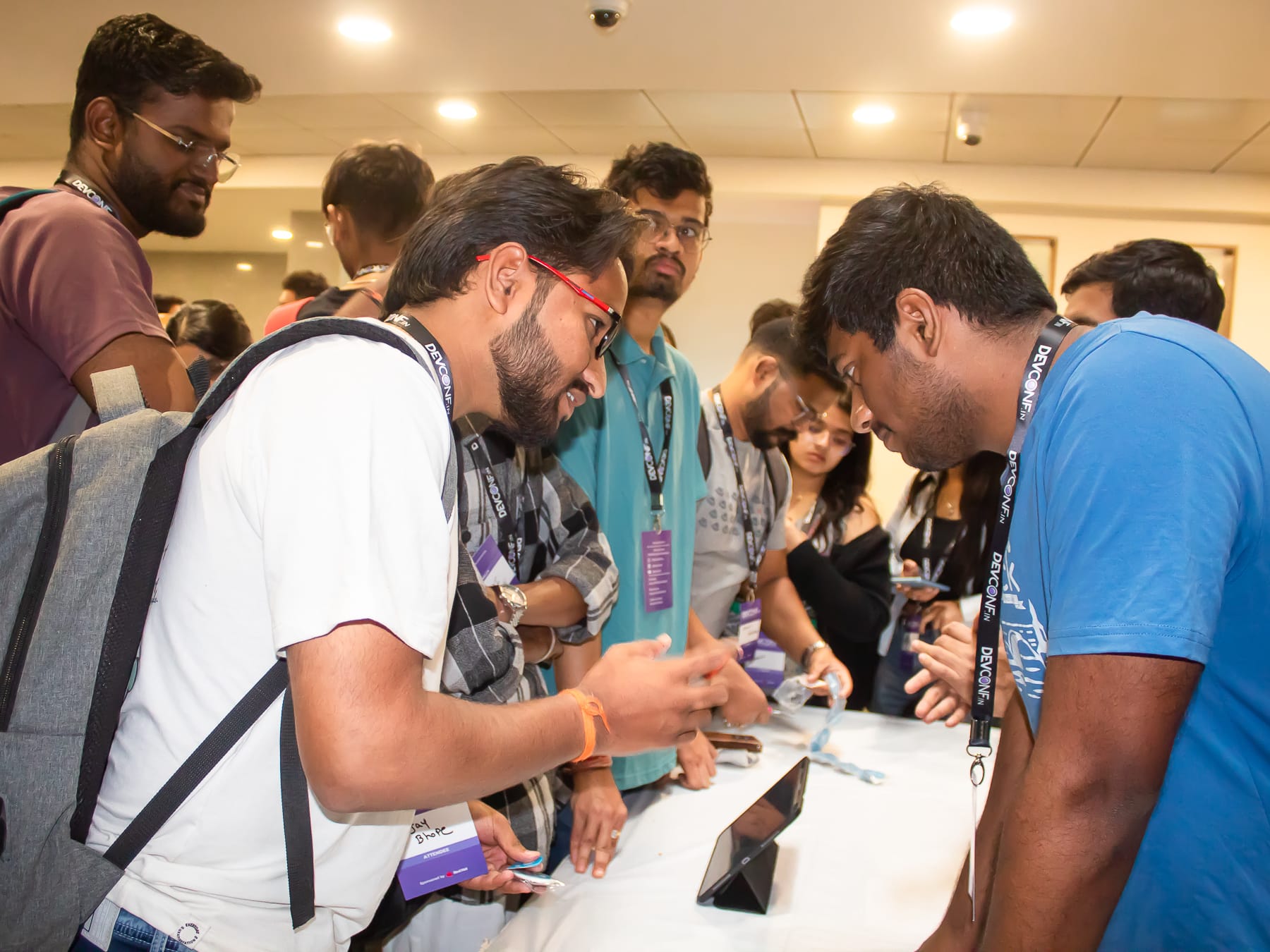
Collection L (Shounak Dey, CC BY-SA 4.0)
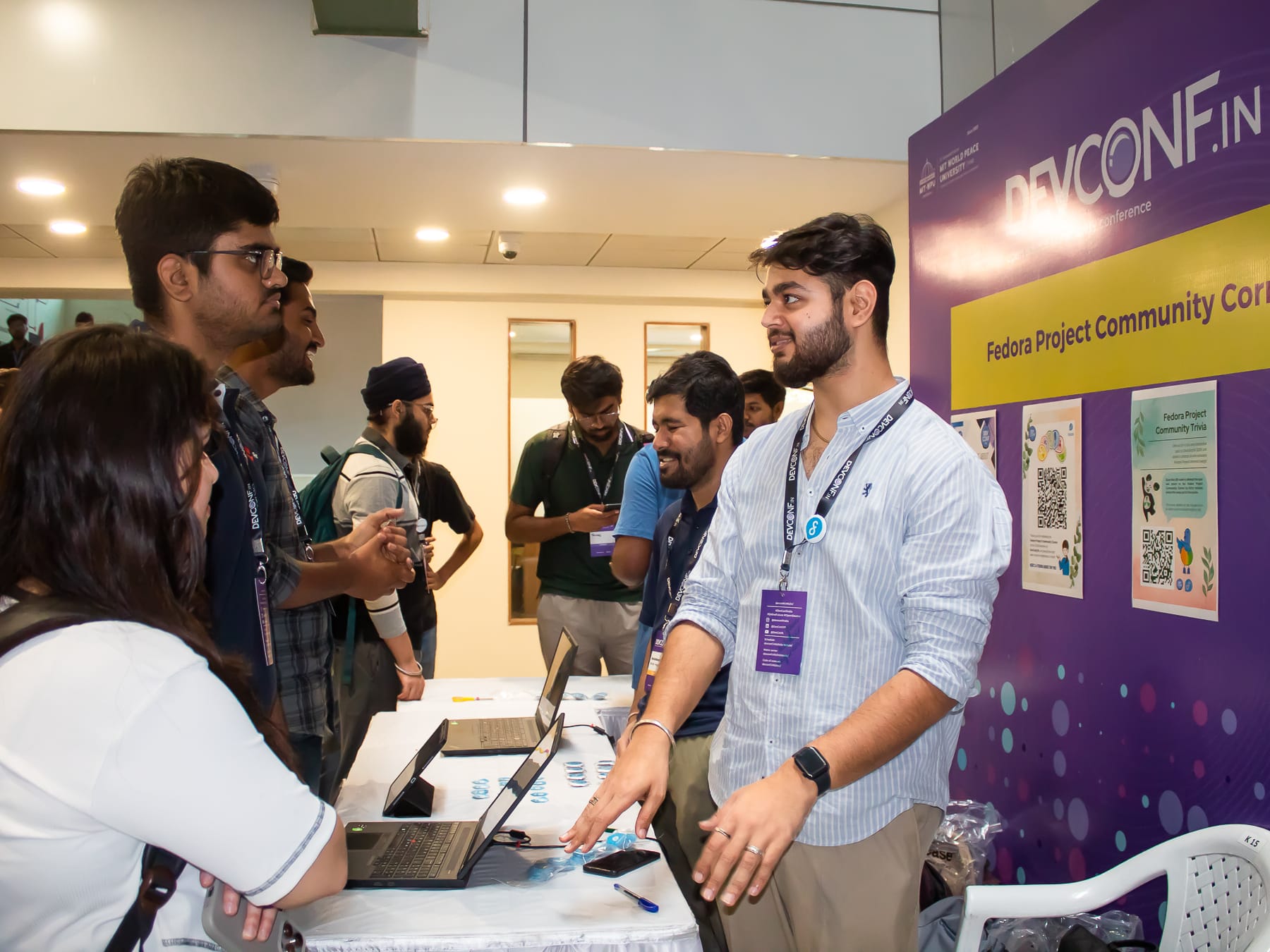
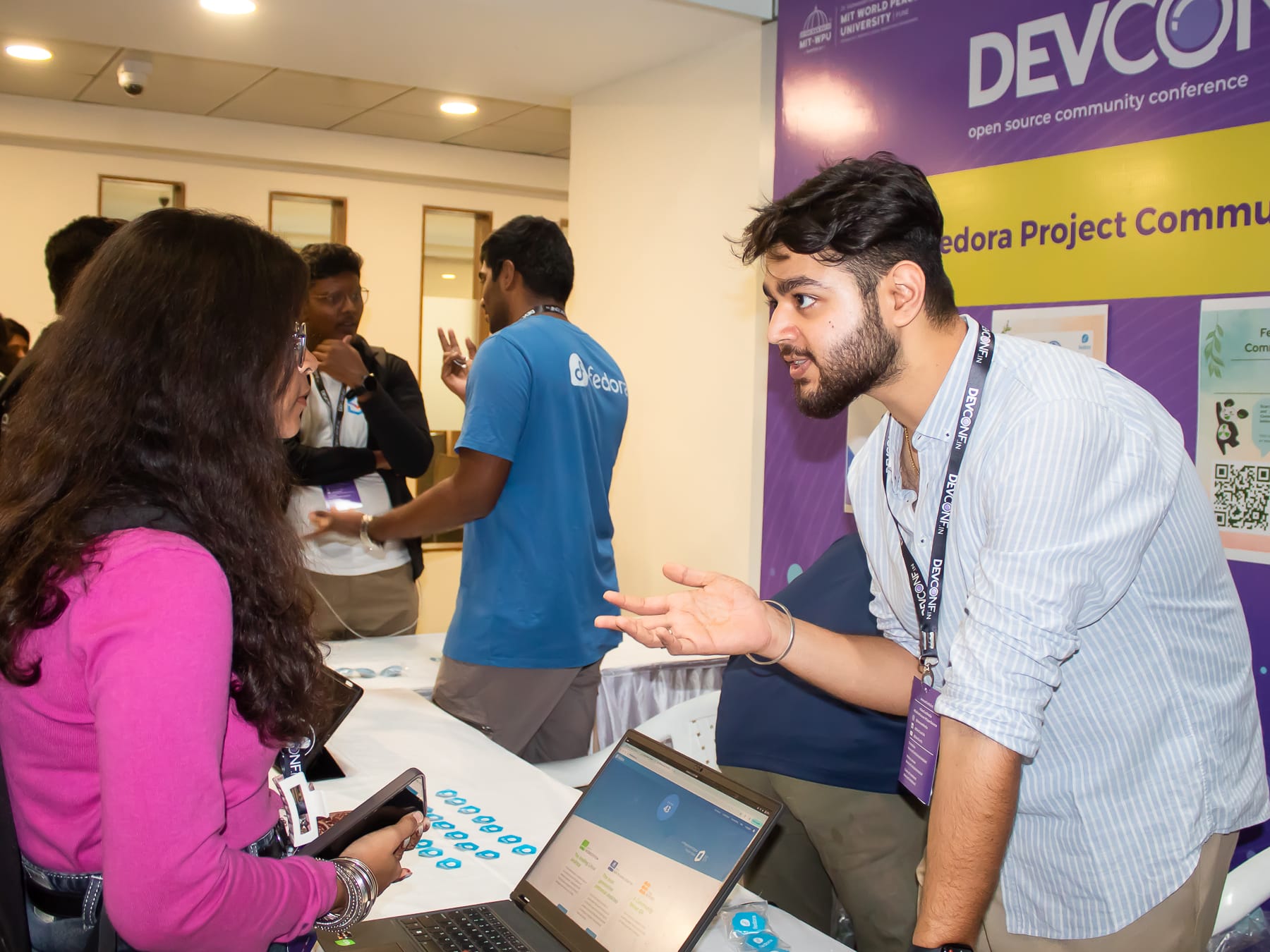
A DevConf.IN volunteer, Rahul Sharma, visited our booth to inform us about the catering being served on the eighth floor of the building at around 0100pm Indian Standard Time. Right around this time, we had a confusing conflict with a fellow speaker or booth participant who we found to be taking away Shounak’s swag pack, claiming it to be theirs since they had left it there for the restroom. While we could not verify the truthfulness of their claim, I sternly asked them to return the swag pack to Shounak and verify with his friends before pressing further. Since he did not bother informing any of the booth staff about leaving behind his objects, we could not be held responsible for any misplaced belongings. For all that trouble, it turned out that his friend indeed had his swag pack with him all along.
Collection M (Shounak Dey, CC BY-SA 4.0)
After reporting this awkward incident to an adjacent DevConf.IN volunteer, Shounak and I decided to head upstairs for lunch. With Matthew leaving, it was down to the four of us handling the booth, so we wanted to ensure that the booth was staffed by at least a couple of folks at any given time. Since both Samyak and Yashwanth mentioned that they were not feeling hungry enough, the two of us decided to scale through sixteen flights of stairs to make it to the eighth floor. It is not that the place did not have elevators, but they were jam-packed, and we would have ended up wasting time waiting for a vacant one to become available, given how popular DevConf.IN 2026 ended up being in terms of attendee count. We also connected with Avadhoot to check on his experience at the conference so far.
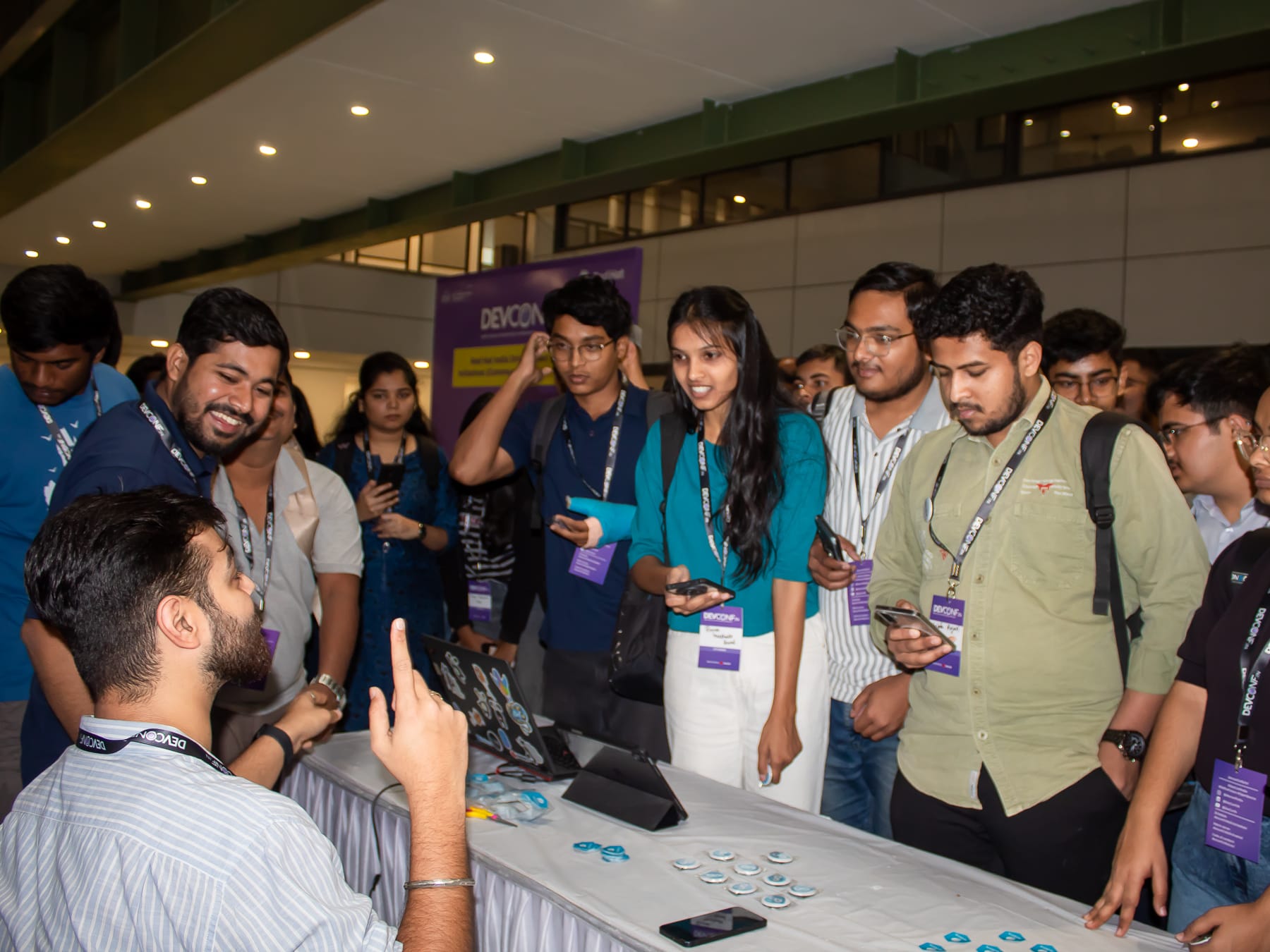
Collection N (Shounak Dey, CC BY-SA 4.0)
We did end up wasting our time, though, since we found a huge queue on the eighth floor at the dining establishment serving volunteers, speakers and staff. Actually, scratch that, it was not entirely a wasteful endeavour because I got to meet up with Brian Proffitt, whom I met after almost a year or so since the previous DevConf.IN. After a brief catch-up and a bio break, the two of us headed back to the booth, since waiting in the queue doing absolutely nothing before spending more time to have food would have been wasteful. Instead, Shounak and I decided to go across the place to see what other booths had to offer, which led me to meet a bunch of community friends and fellow employees. We met Sudhir Dharanendraiah while we were exploring, meeting after almost a couple of years.
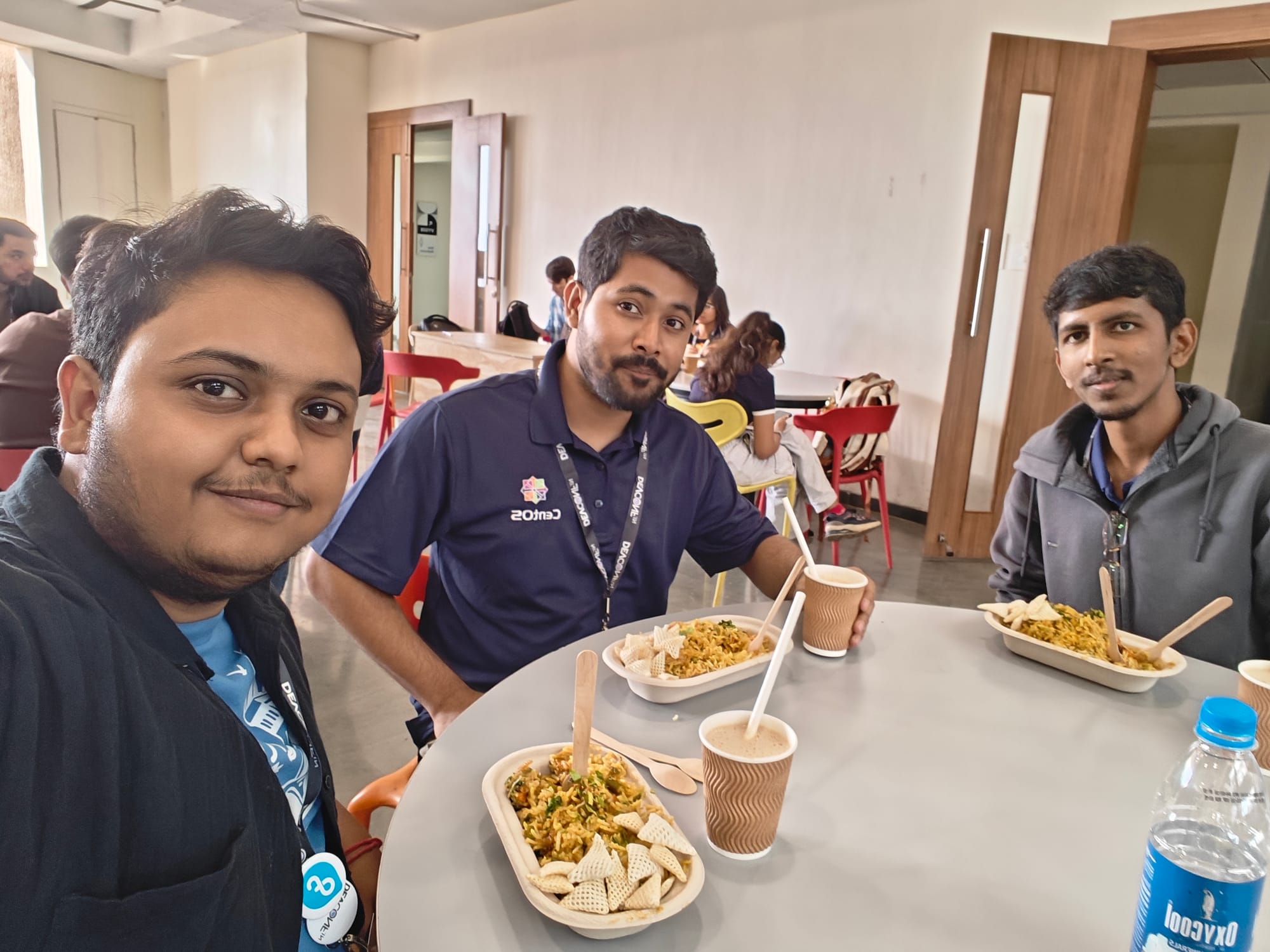
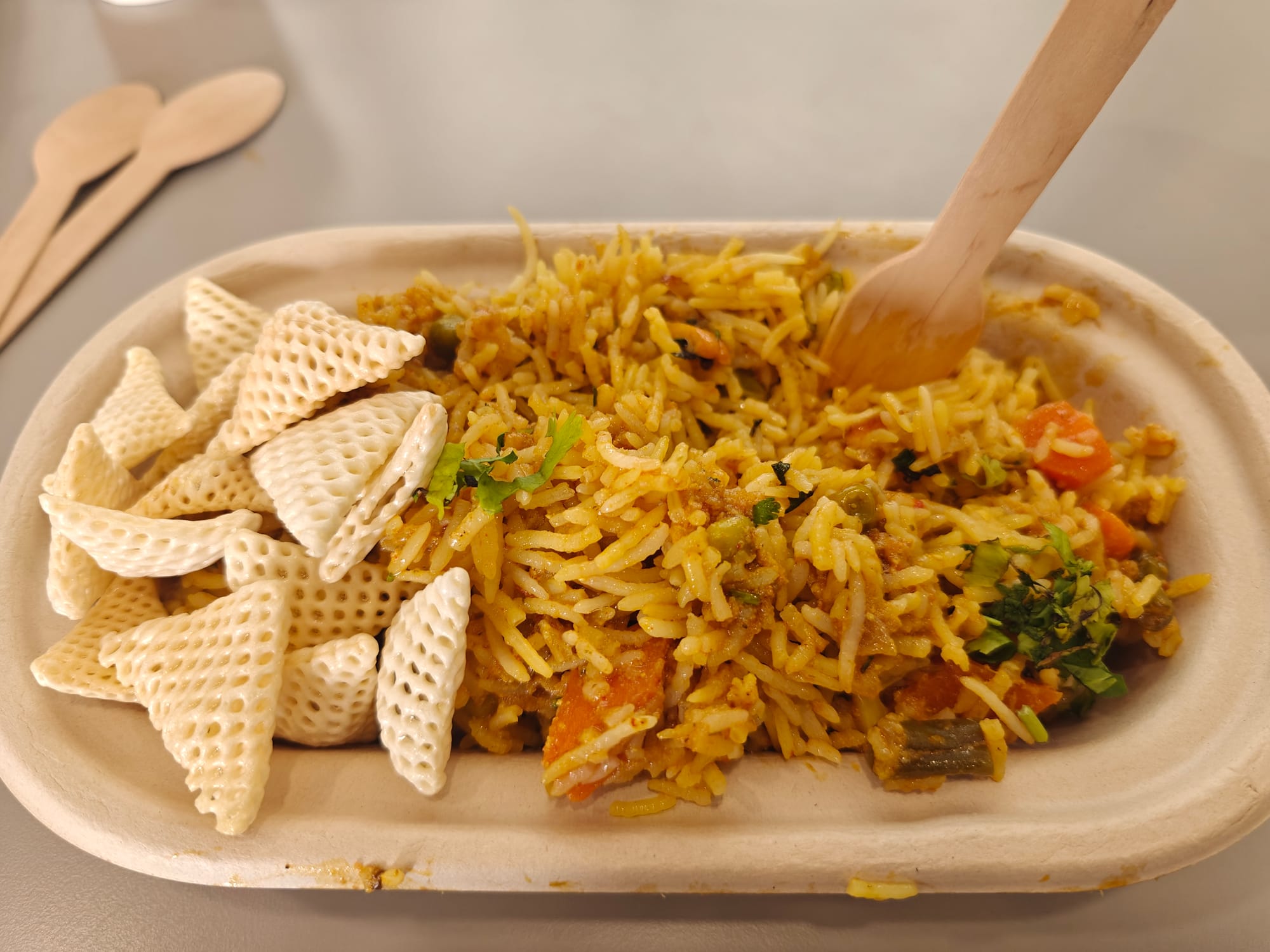
Collection O (Akashdeep Dhar, CC BY-SA 4.0)
He remarked that the booth personnel from the Red Hat India Communities ran out of their swag during the first few hours of the event's commencement and praised how we kept visitors engaged throughout the day. He also said that not combining the Fedora Project community booth with the Red Hat India Communities was the right call, since that allowed us to be crystal clear in our messaging that the Fedora Project and Red Hat do indeed care about India and APAC users and contributors. We were even asked whether we had a regional community presence or meetup cadence, which gave us something to explore and consider from the Fedora Mindshare activity perspective. The two of us finally came back to the booth, letting Samyak and Yashwanth head away for lunch.
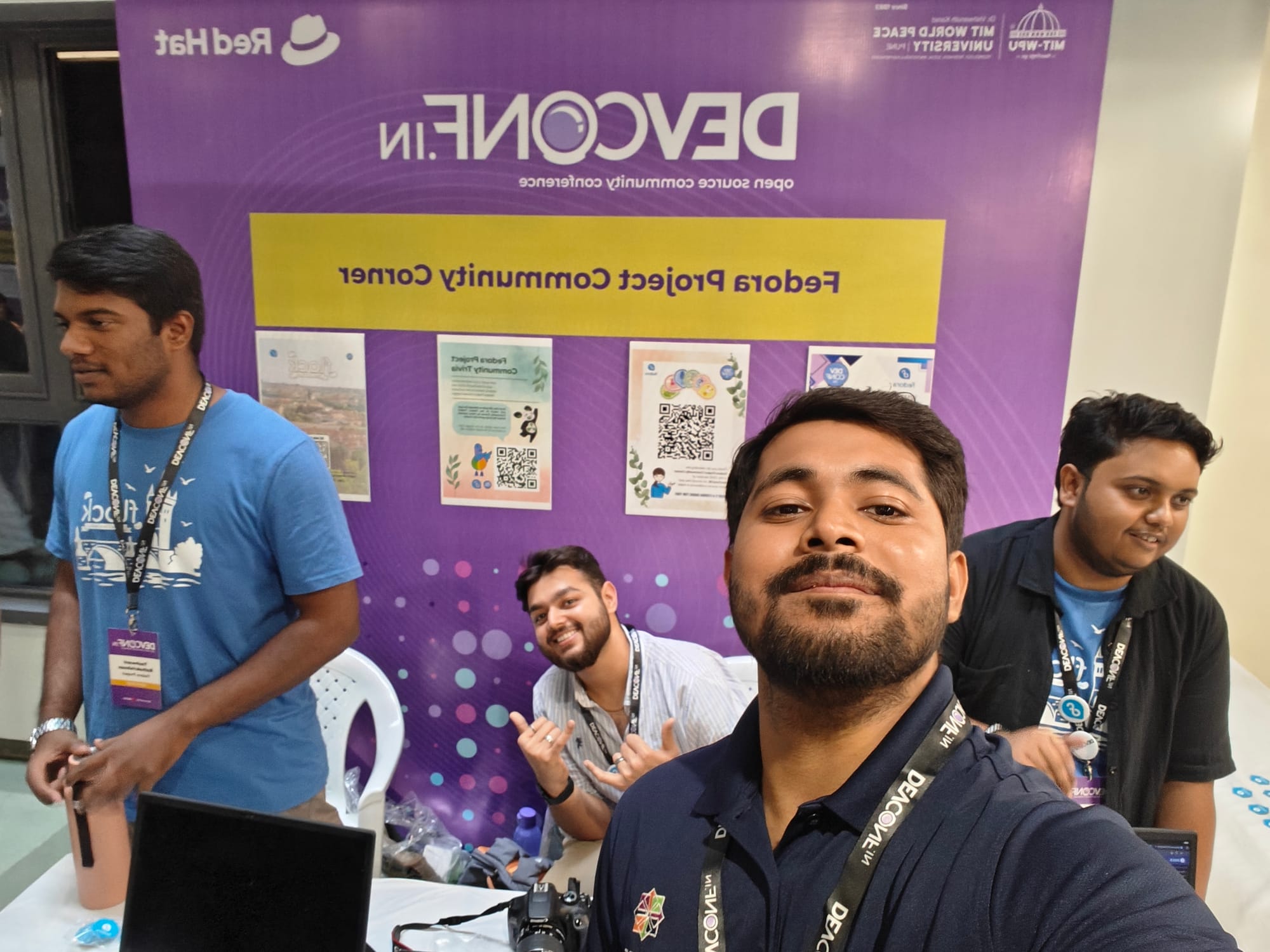
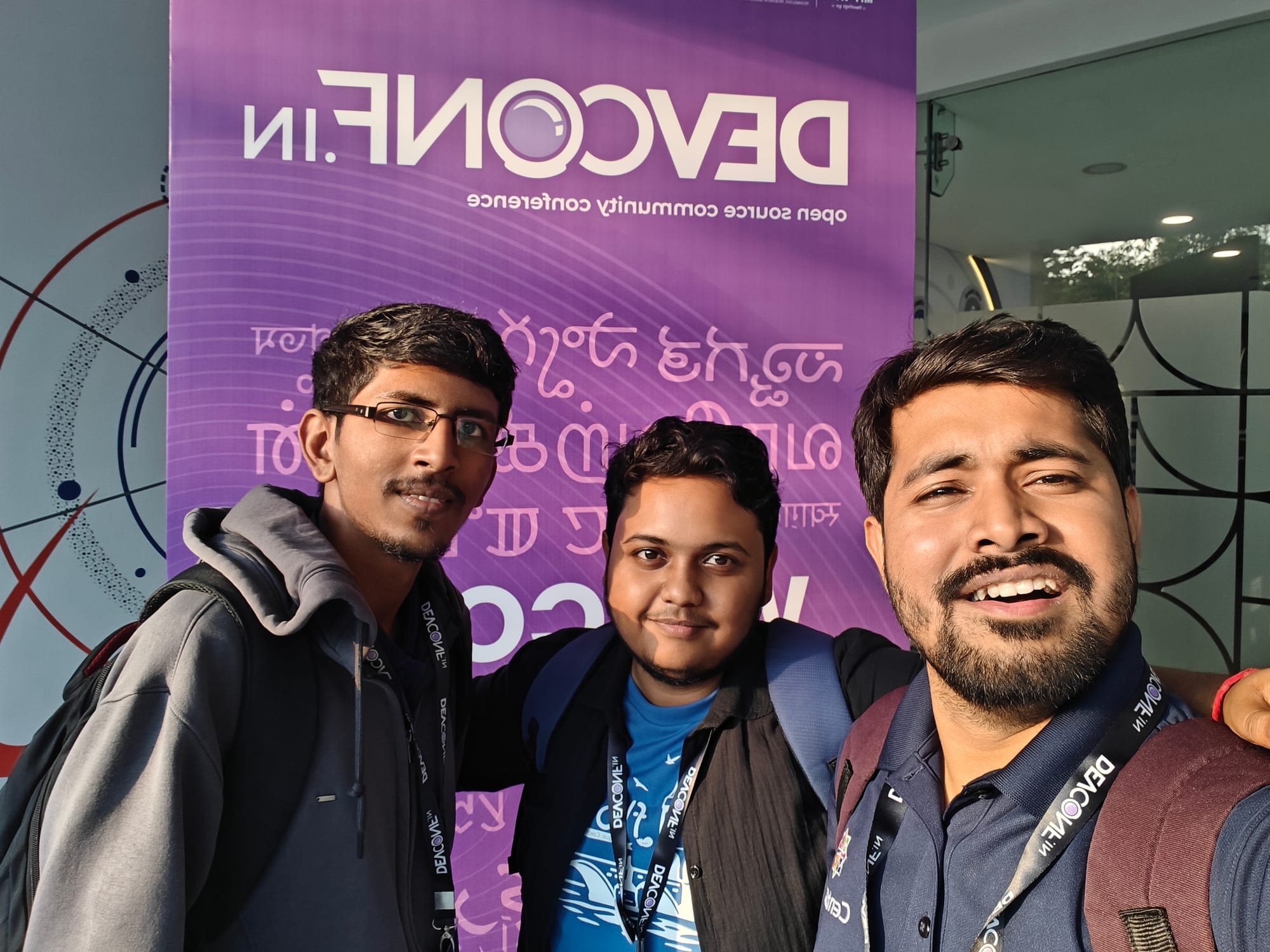
Collection P (Akashdeep Dhar, CC BY-SA 4.0)
The other major questions and feedback that came to us about Fedora Linux had to do with what we were planning to do around artificial intelligence. Being a Fedora Mindshare representative to the Fedora Council at the time, and also someone who proposed the creation of an AI-assisted contribution policy, I elaborated on how inclusive our community had recently become towards policy-abiding AI-assisted contributions. I also emphasised that with subprojects and SIGs around AI, ML, and PyTorch, our focus was to establish Fedora Linux as a general-purpose platform of choice for generalists, developers, sysadmins, or enthusiasts to build AI-powered technologies on, rather than have AI-based solutions that no one asked for enabled by default in our primary offerings.
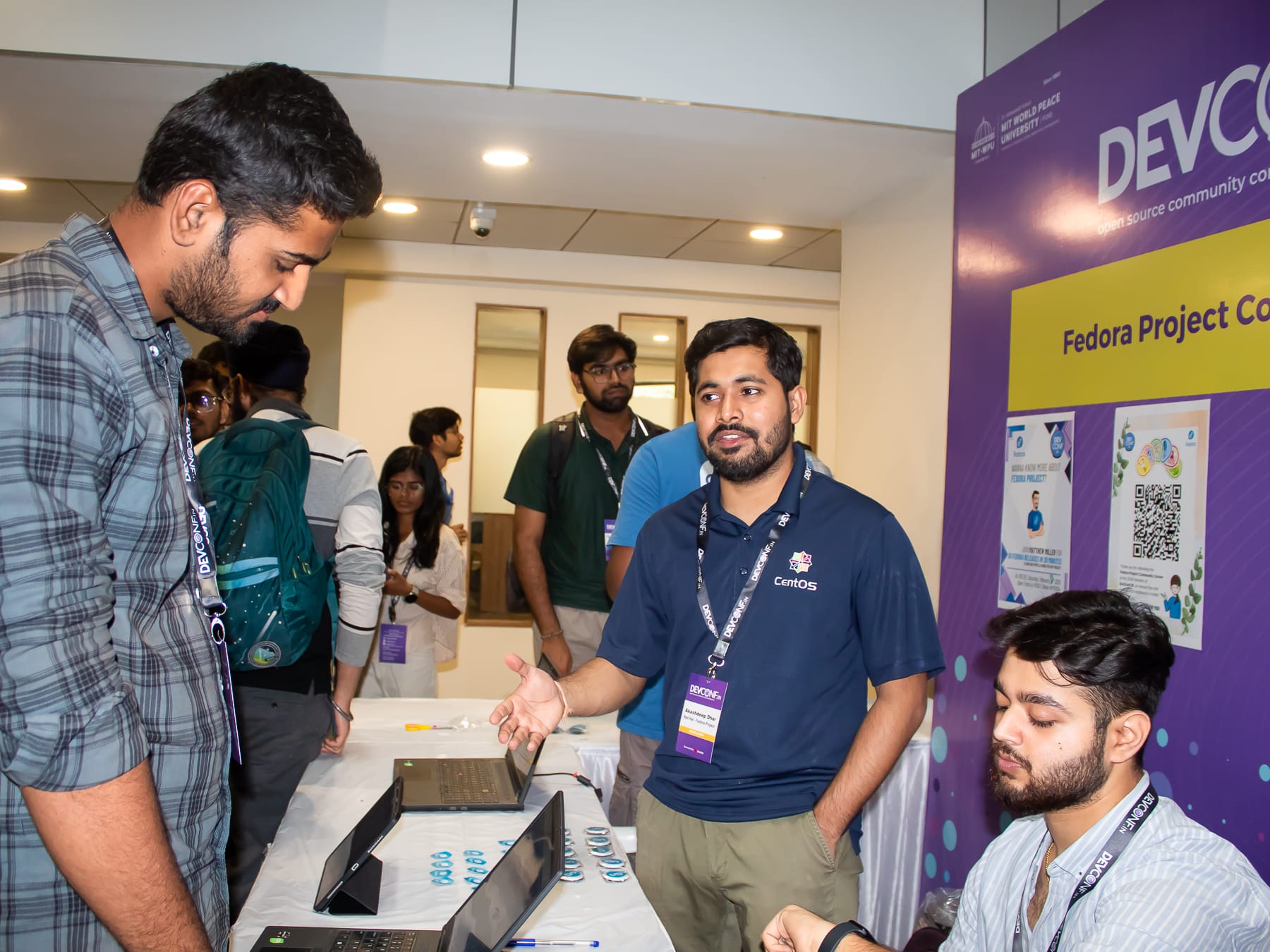
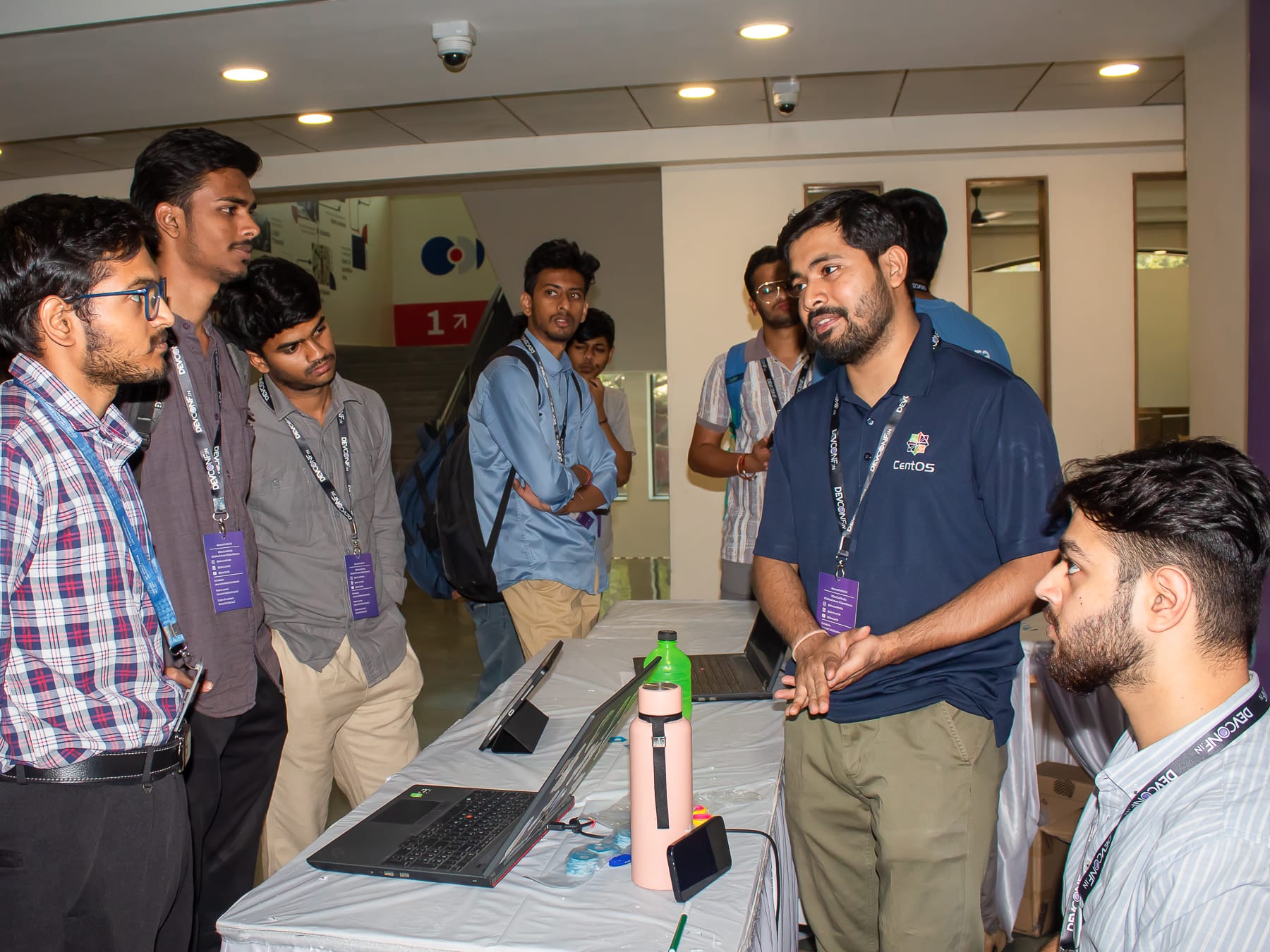
Collection Q (Shounak Dey, CC BY-SA 4.0)
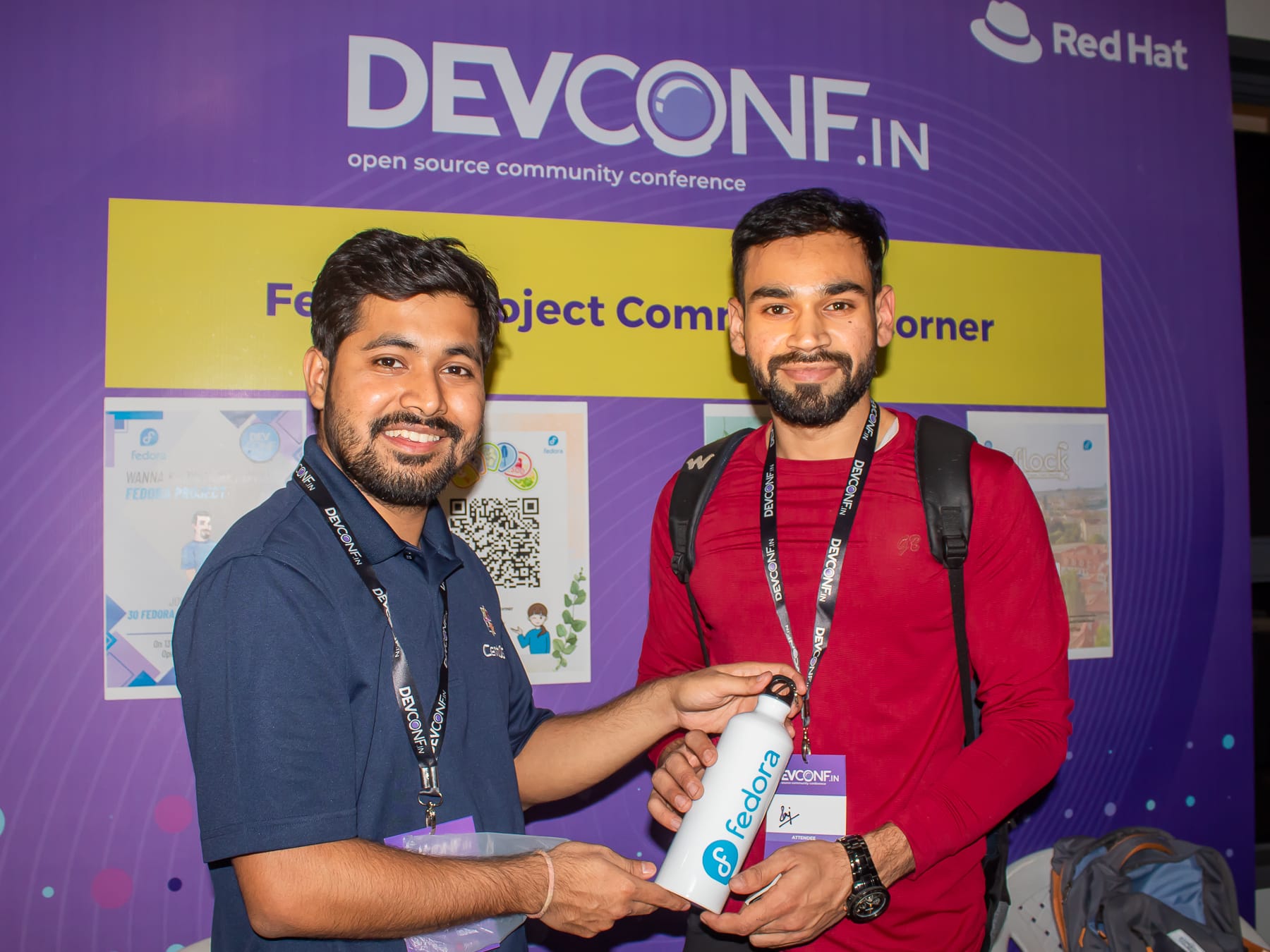
We met Pravin Satpute, who suggested that we have lunch at the cafeteria on the fifth floor, and after letting Samyak and Yashwanth return from their exploration, we headed there with Avadhoot. The dining choice was limited to a Vegetarian Biryani and Cold Coffee, but at around 0230pm Indian Standard Time, that felt like a divine serving. We were able to get ourselves an elevator this time around, and after a brief catch-up with the likes of Saumili Dutta and Kashyap Ekbote, both of whom I met previously during GNOME Asia 2024 in Bengaluru, we returned to the booth. I made it a point to remind the booth crew to stay hydrated now and then, given just how easy it could be for folks to forget about self-preservation after being overwhelmed by almost 600 visitors since we reached the conference.
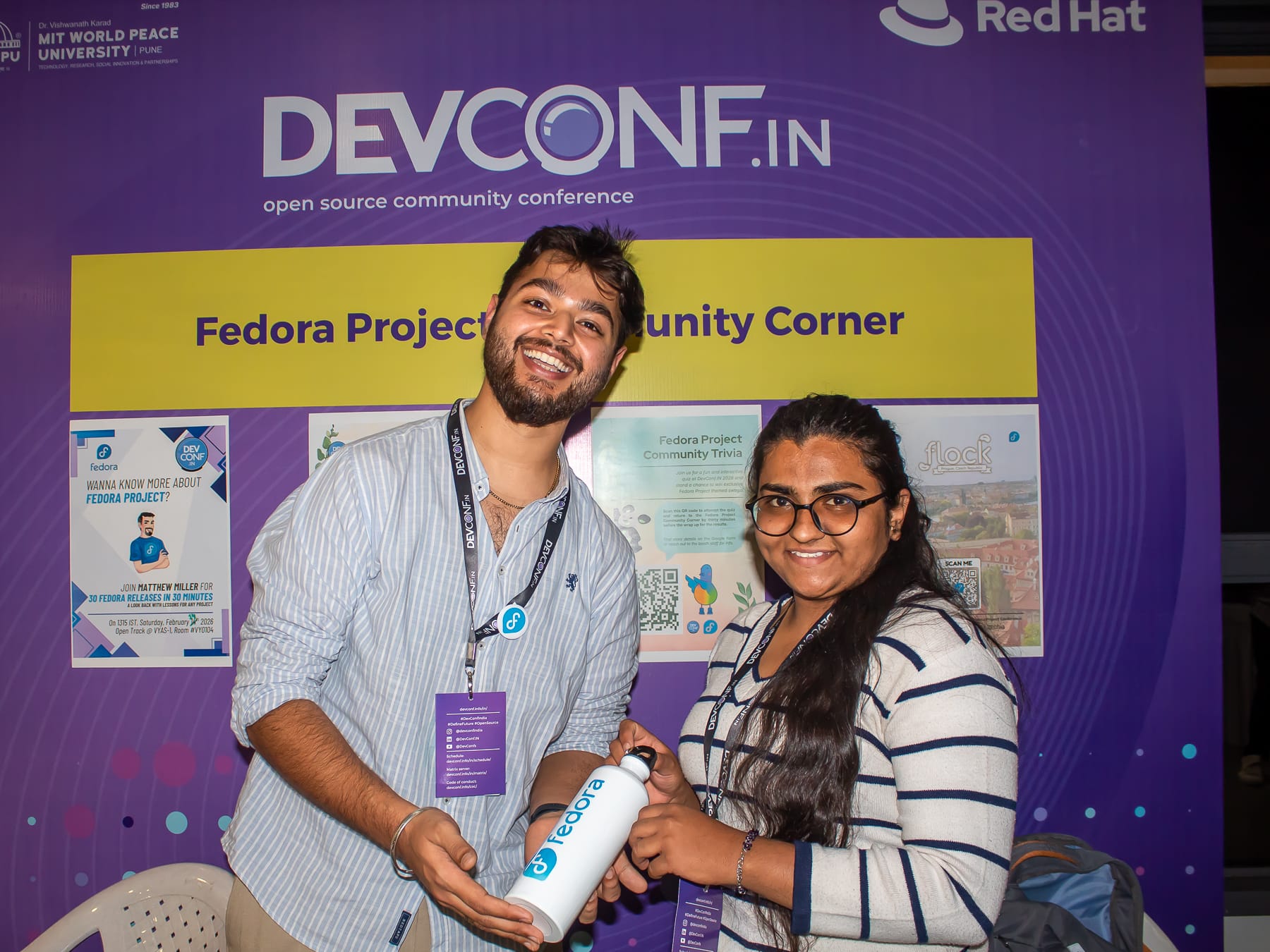
Collection R (Shounak Dey, CC BY-SA 4.0)
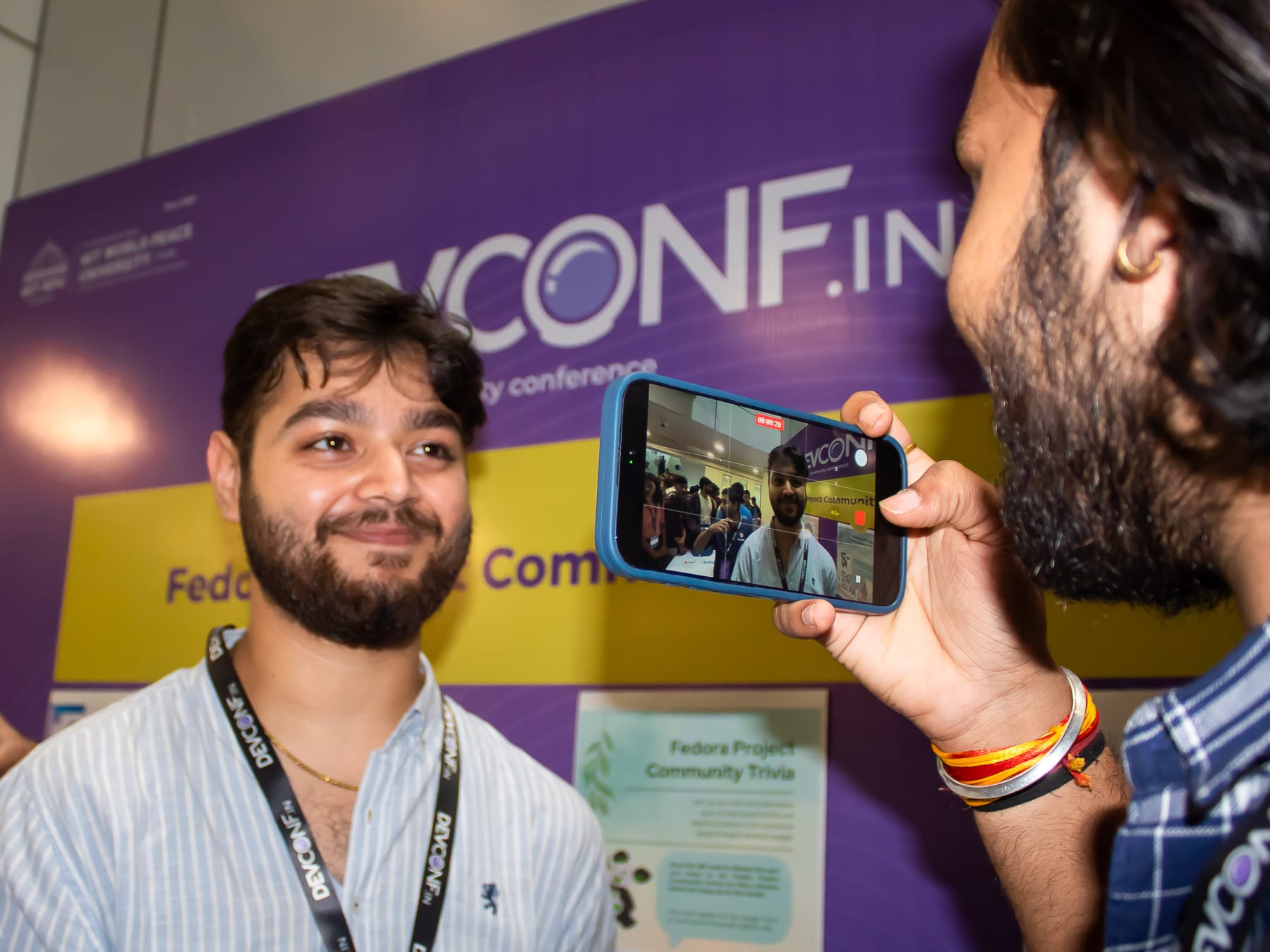
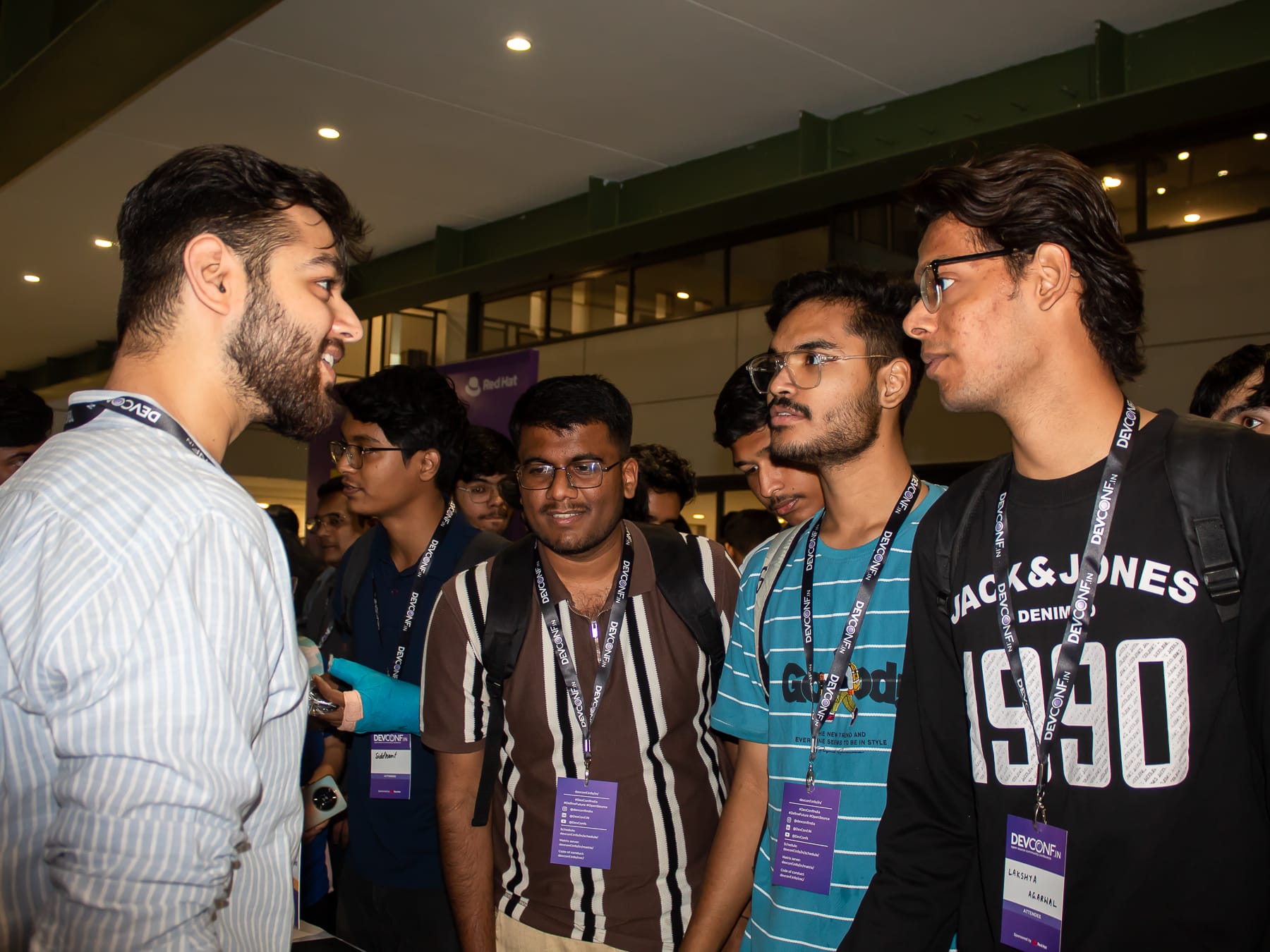
Coincidentally, I met Harshavardhan Sharma from openSUSE, whom we had met in the past in another conference, along with Sahil Tah, a college senior from my alma mater. DevConf.IN 2026, did manage to bring like-minded individuals into one place, regardless of which industry they belonged to, showing that openness and innovation are indeed the way forward when it comes to technology. Rajan made a visit to the Fedora Project Community Corner around that time, and he admired how we kept visitors occupied while providing them with things to learn and swag to collect. We were also soon visited by the likes of Amita Sharma and Sudhir Menon, whom we caught up with after a long time, while offering them the warm embrace that the Fedora Project’s “Friends” foundation is known for.
Collection S (Shounak Dey, CC BY-SA 4.0)
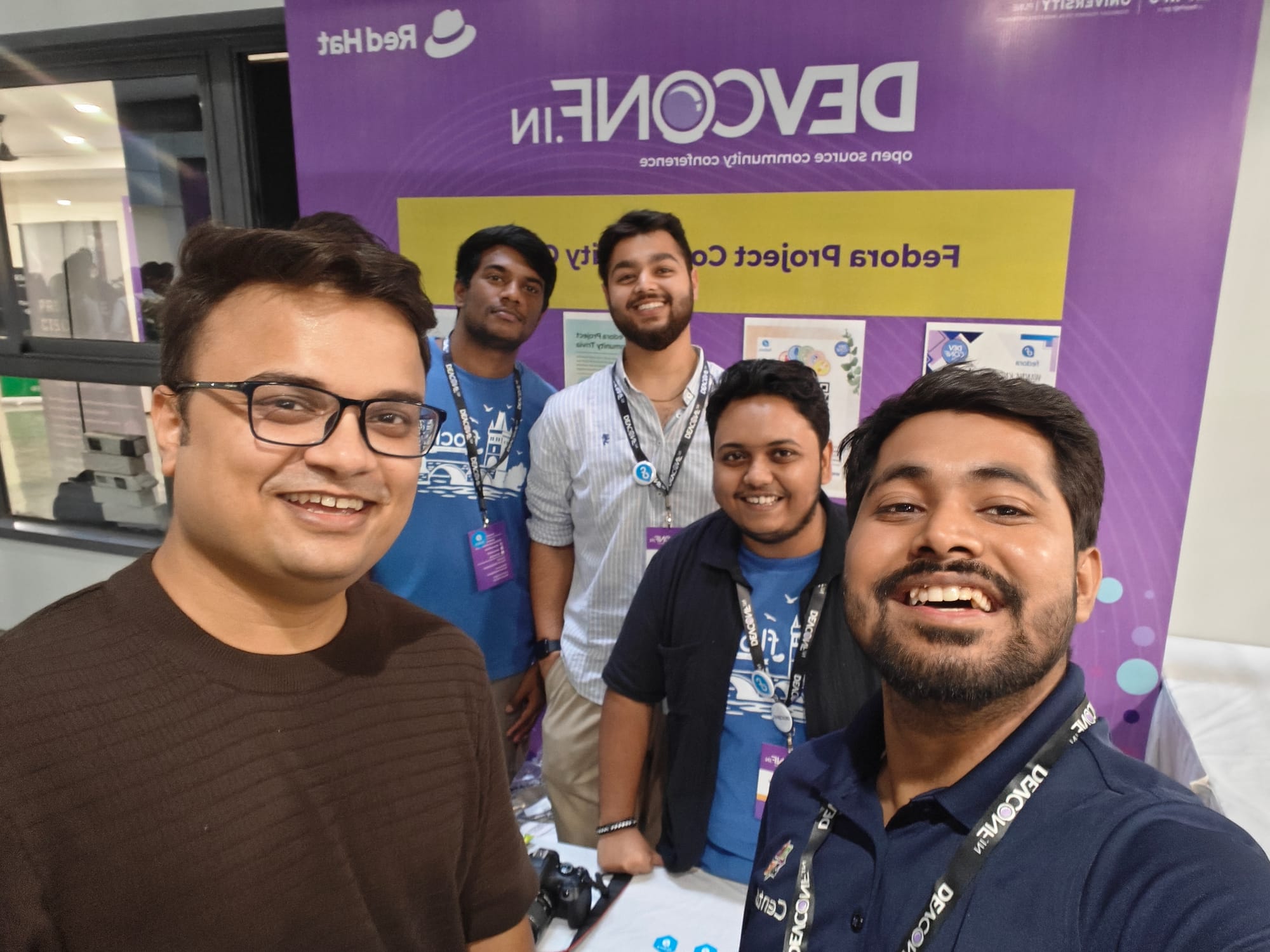
I was also briefly visited by some folks who thought that we had mistaken the answer keys in the Fedora Project Community Trivia, but to their surprise, those were made tricky on purpose. I provided them with the context of how I planned those deceptively difficult questions while emphasising that we wanted the four winners each day of the conference to feel special about their victory. Since I had procured eight limited-edition Fedora Project-themed sippers for the winners, the attendees not only had to exhibit their community knowledge by getting full marks but also had to be lucky enough to emerge victorious in a raffle. We wanted folks to return to the booth thirty minutes before closing time for the announcements.
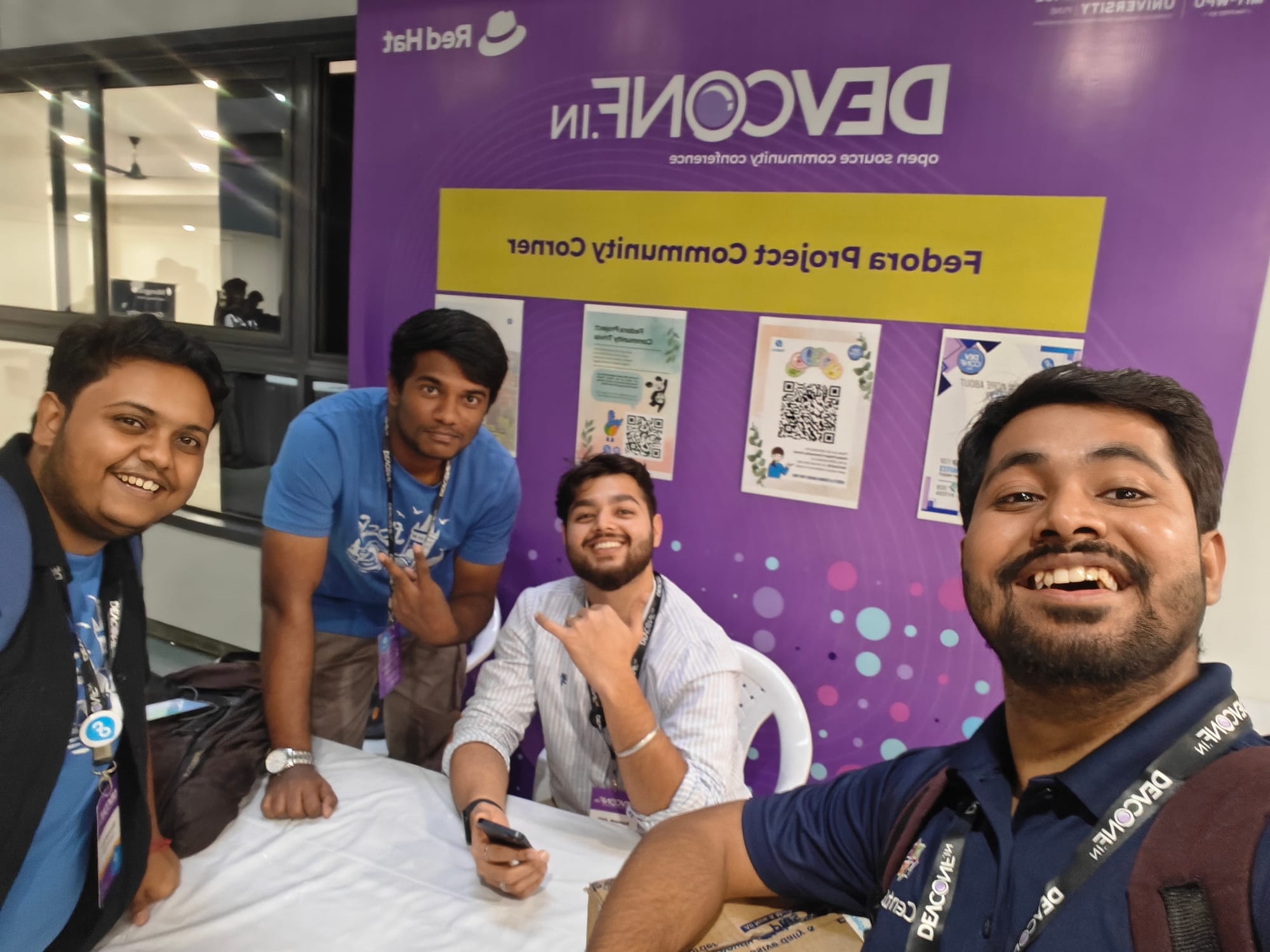
Collection T (Akashdeep Dhar, CC BY-SA 4.0)
While Samyak worked on populating the raffle with the high scorers on his laptop, I checked with Sayak Sarkar, who was visiting DevConf.IN, just like the year before. As the Vyas Building gave us very poor cellular reception, it was incredibly challenging to point him in the correct direction, especially since, while the venue remained the same as the previous year, the actual location had moved. For their first experience manning a community booth, I could not help but watch from a distance just how well both Shounak and Yashwanth did as volunteer contributors as I waited for Sayak to turn up at the Fedora Project Community Corner. At around 0430pm Indian Standard Time, I caught up with Sayak and introduced him to the Indian Crew as the curious crowd started gathering for the results.
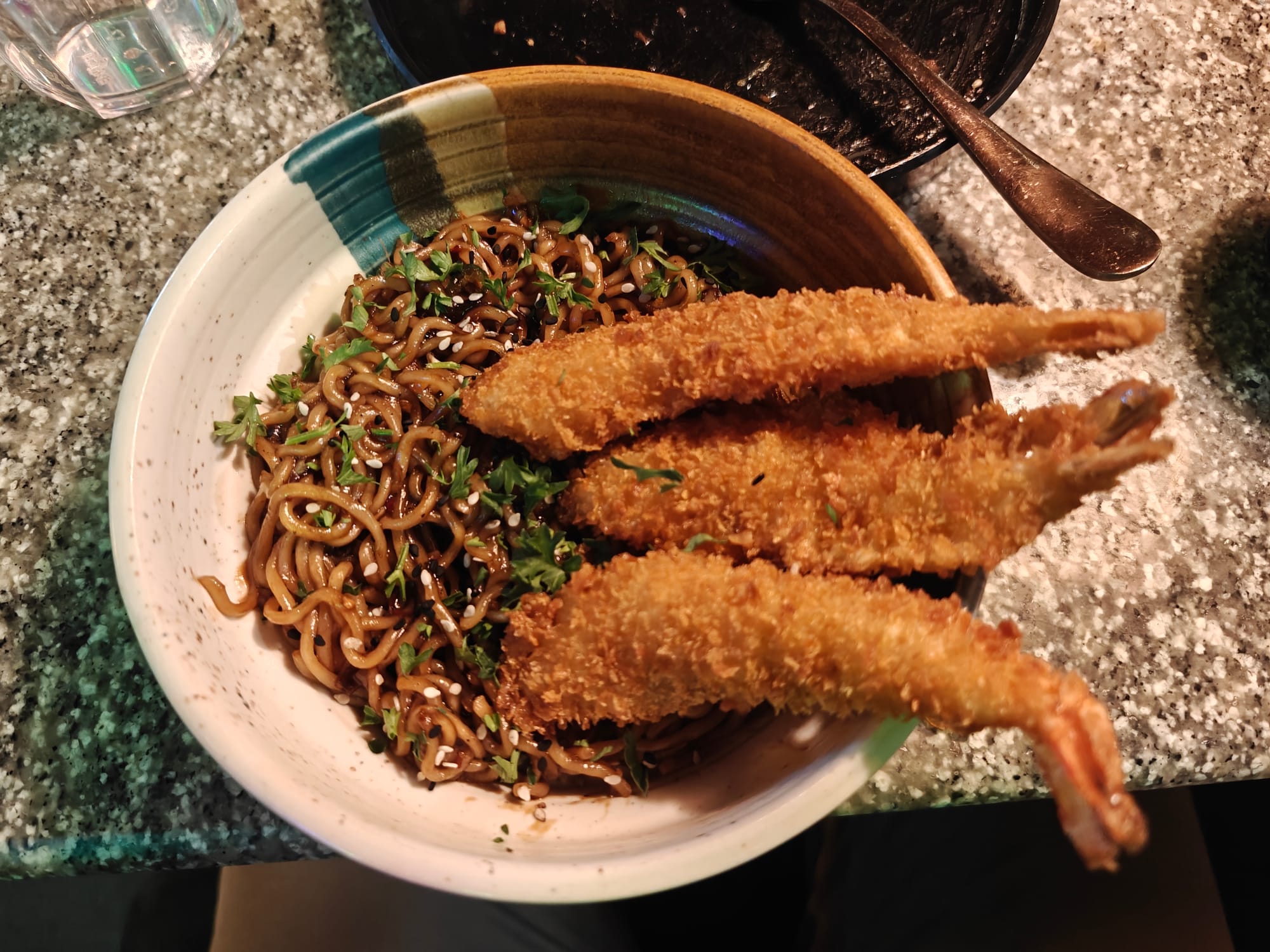
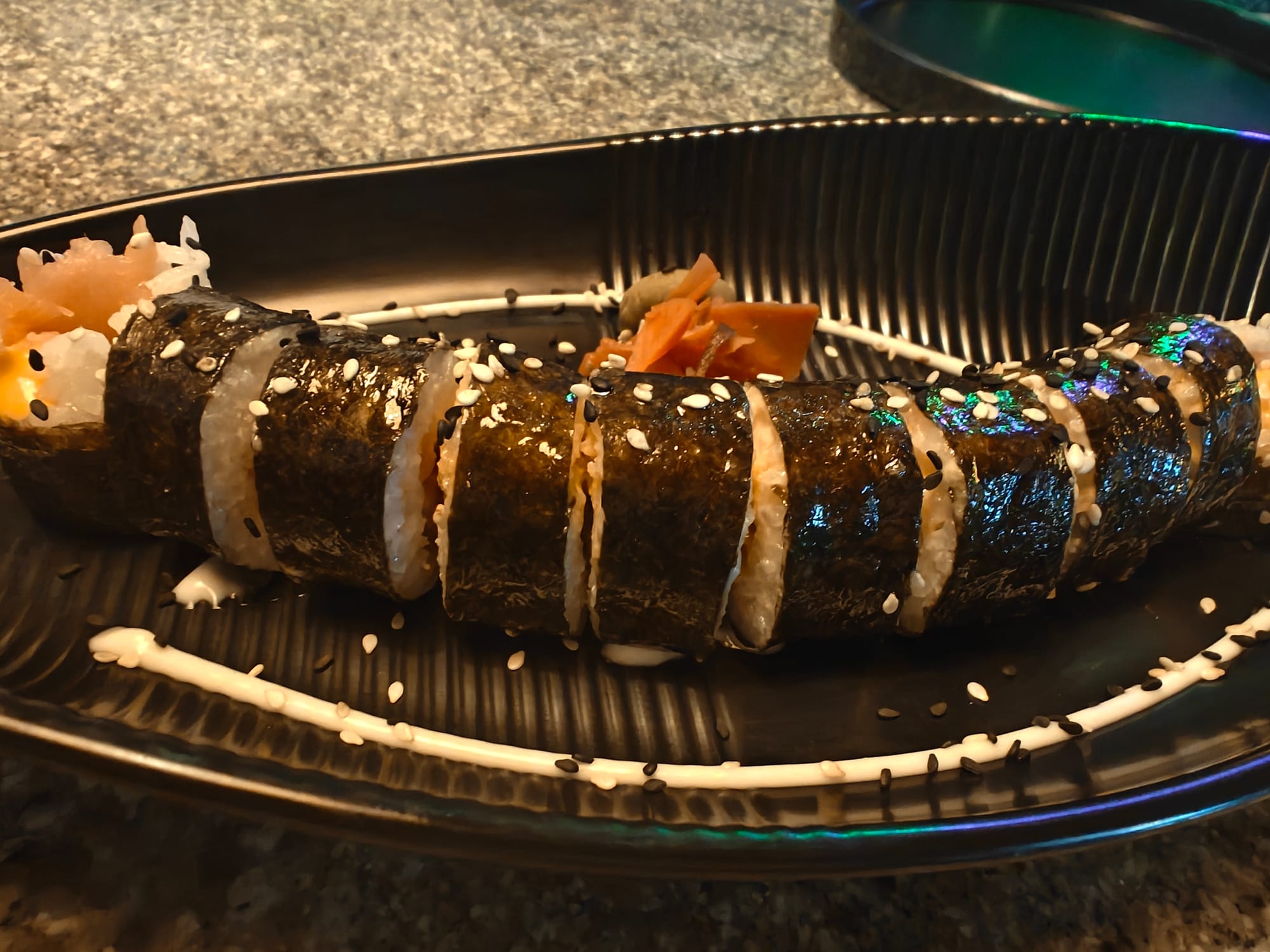
Collection U (Akashdeep Dhar, CC BY-SA 4.0)
With the four winners being announced and felicitated by both Samyak and me, the visitors cheered for the winners as well as for the exciting activity. We clicked a few more pictures with Matthew before he went on his way to attend the dinner with the DevConf.IN speakers, organisers, and members. While I was invited to the dinner as well on behalf of the Fedora Project, it made little sense to me not to go out with the hardworking Fedora Project Indian Crew instead. In one of the conversations with Sayak and Shreyank Gupta, I was pleasantly surprised to learn that Shreyank was also a fellow Bengali, since I had always interacted with him in either English or Hindi for the past five years or so. After a few more pictures were taken by Shounak at the booth, we decided to start wrapping things up for the day.
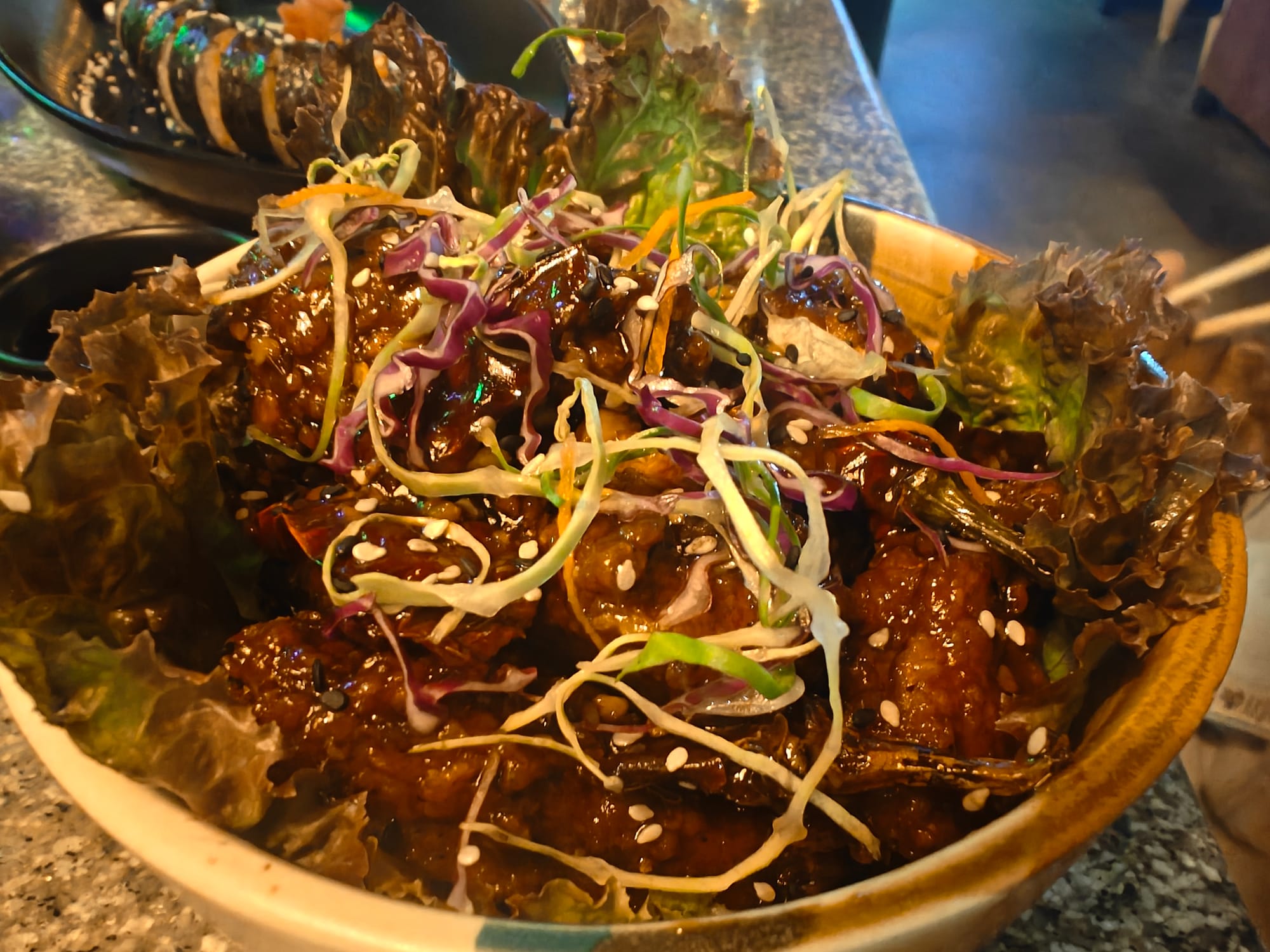
Collection V (Akashdeep Dhar, CC BY-SA 4.0)
We unfortunately had to send some visitors back, and ask them to return the next day, who wanted a demonstration of Fedora Workstation at our exhibits. We had more than half of the swag packs left in our inventory, even after giving away a huge number of them to be cross-shared by the Red Hat India Communities booth personnel. After taking an inventory of all the belongings we had with us, we started looking for Uber rides back home. While we left the posters behind on the backdrops, we decided to take everything else with us to avoid misplacing them. It took a while for that to be confirmed, but after Samyak and Yashwanth got theirs, Shounak and I got ours, and we decided to leave for our homes around 0530pm Indian Standard Time, since we planned to reconvene for dinner later that day.
Collection W (Akashdeep Dhar, CC BY-SA 4.0)
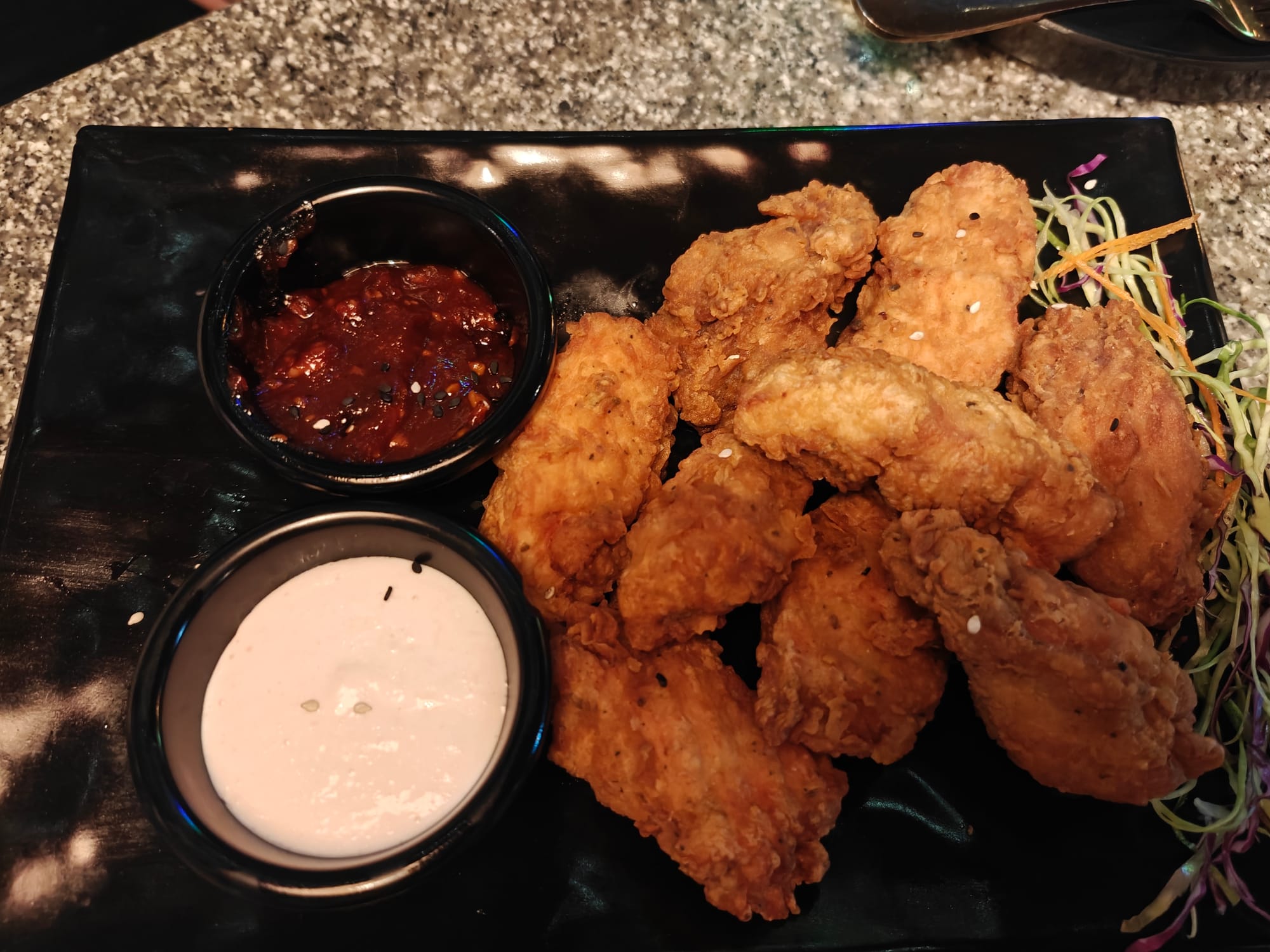
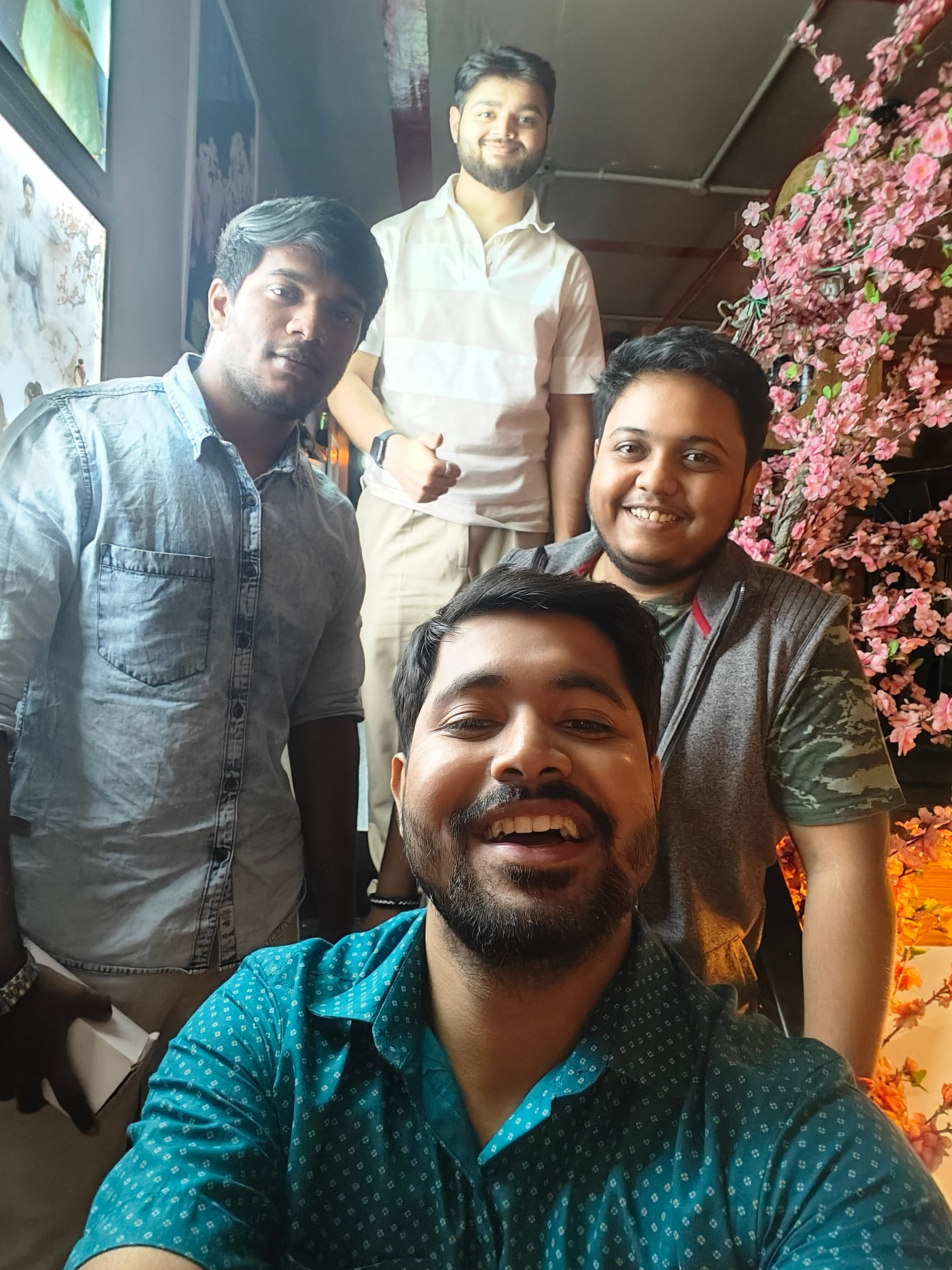
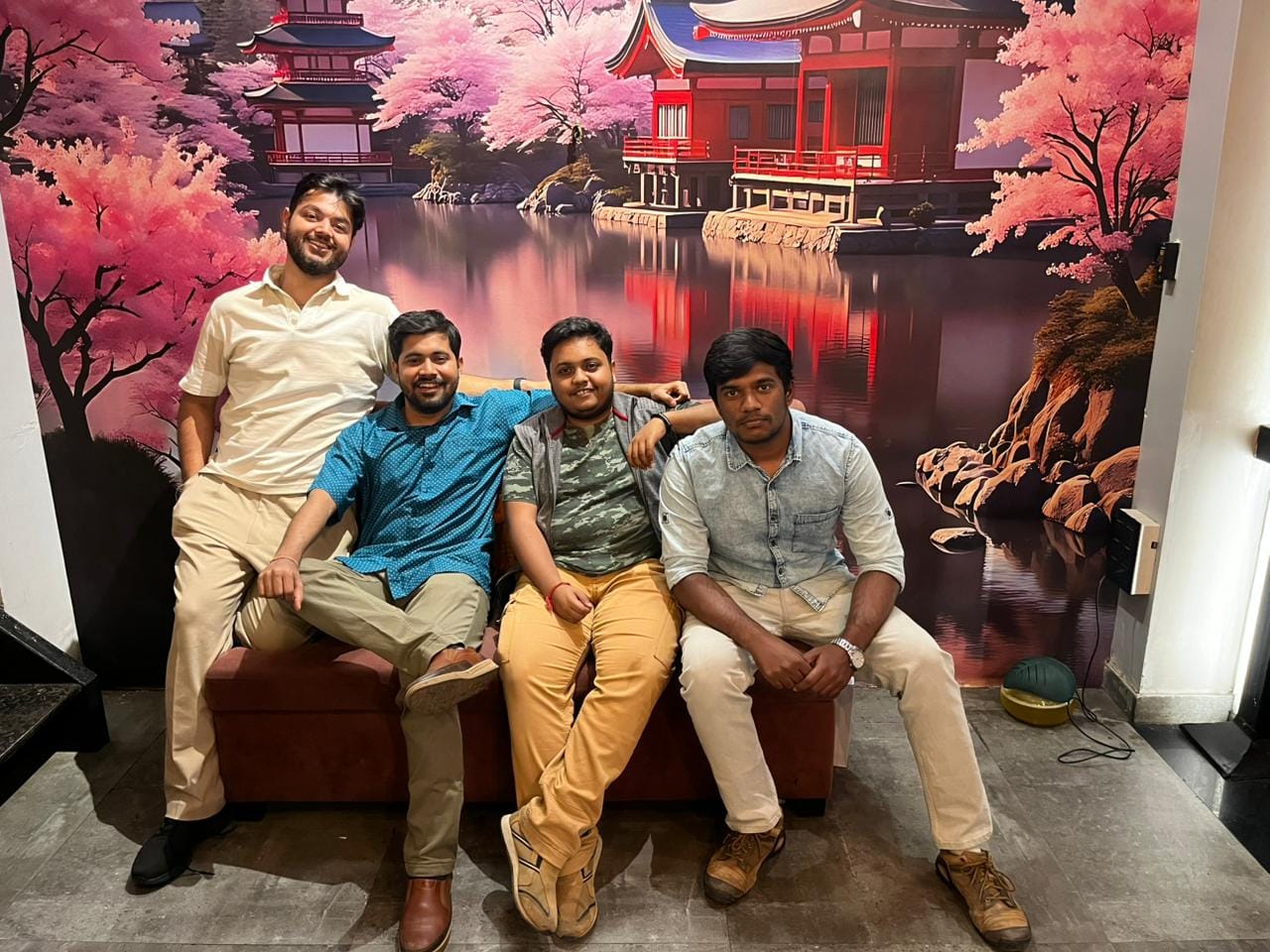
After a rather uneventful but lengthy Uber drive, Shounak and I made it back to our homes. The evening went quite smoothly, with a pre-booking for dinner done at Wasabi15 under my name and Samyak and Yashwanth arriving early by 0800pm Indian Standard Time. Using the budget that I had previously requested from my management, we were able to have a great time unpacking from a busy day running operations at the Fedora Project Community Corner. Yashwanth sought advice on how he could take his contributions further, and Shounak shared how he got started in free and open source software contribution. With some great Asian cuisine and even greater conversations, we called it a night at 1000pm Indian Standard Time and went back to our places to prepare for the next day.