Maintainer Summit - IndiaFOSS 2026
IndiaFOSS 2026's Maintainer Summit brought together FOSS maintainers from the APAC region for discussions on contributor retention, codebase hosting, semantic diffs, generative tooling, data protection and translation tooling, of which the local Fedora Project presence had been an integral part of.

Theme
Experience
Marking the second Indian FOSS event for me, day zero of IndiaFOSS 2026 by FOSSUnited Organization had the Maintainer Summit planned for it. This had a separate registration apart from the main conference and hence had a smaller footfall at Samagata Foundation. As the invitation email required us attendees to be at the venue at 0900am Indian Standard Time sharp, I decided to get a head start to beat the Bengaluru traffic on Friday, 25th September 2026. As I had my hotel check-in later on that day, I also had to make a brief stop at SRS Springs And Spa Hotel to leave my luggage before finally making it to the event venue. Leaving on an Uber ride at around 0730am Indian Standard Time from Yelahanka Crossing, I surprisingly witnessed much lighter morning traffic than I expected while heading from the outskirts into the metaphoric heart of Bengaluru city.
Simply put, I seemed to have greatly overestimated the traffic situation. Or maybe it was the Friday morning doing wonders. I was able to reach the first stop by around 0815am Indian Standard Time, giving me roughly 45 minutes to cover the next distance. Leaving my check-in luggage with the trusty receptionist of SRS Springs and Spa Hotel, I chatted with the fellow members on the event's official Telegram group until I reached my stop. I was almost certain that I was one of the first folks to make it to Samagata Foundation, after being helped by Ansh Arora in navigating the sprawling center. While Rajan Shah assured me of his availability, he also mentioned that he would join later with Veer Kumar Patil, Shivraj Patil, Deepesh Nair, and Gaurav Kamathe. That not only meant that I was on my own there but also that I had a great opportunity to make some new Fedora friends too!
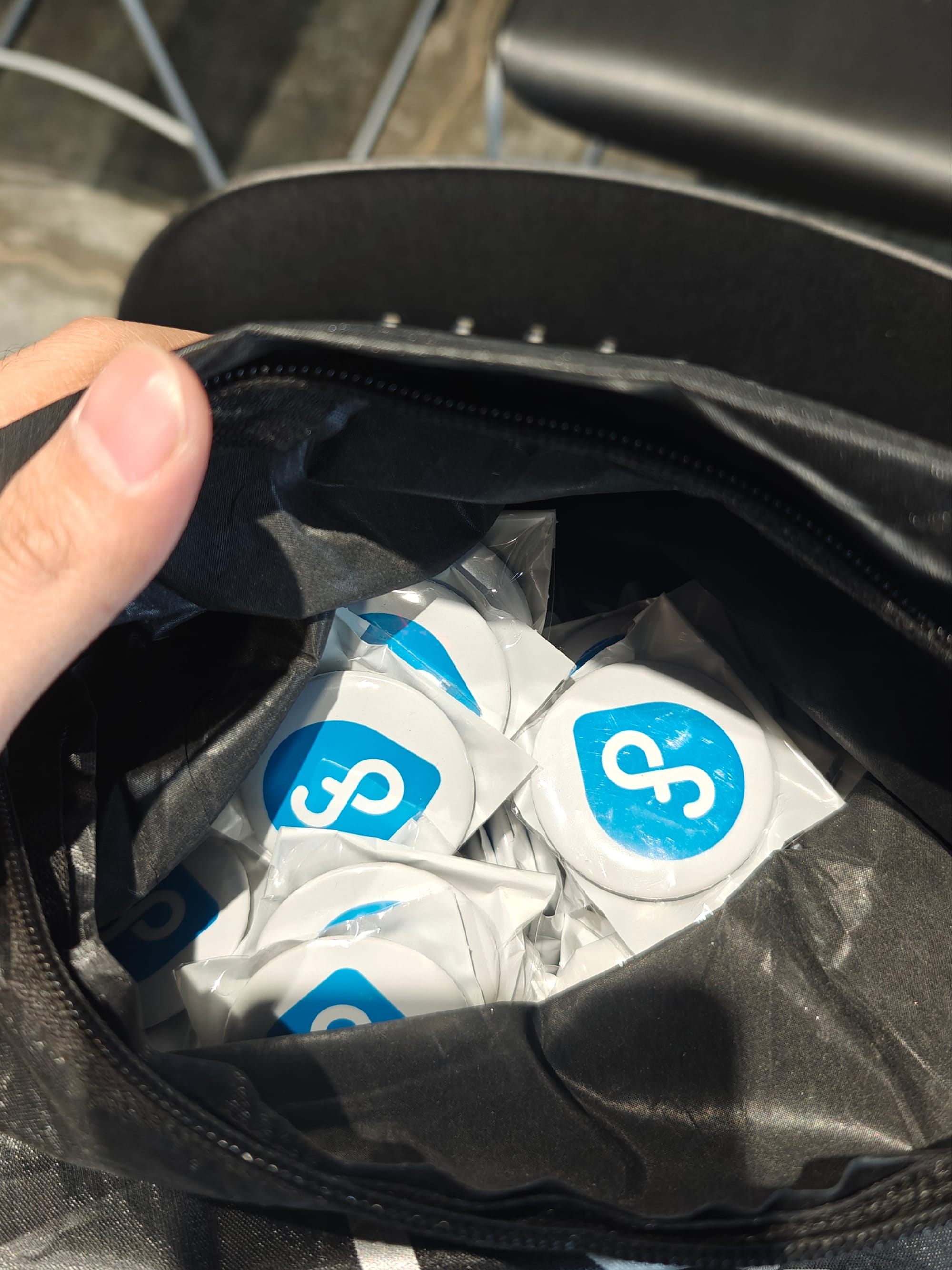
With the attendees slowly rolling in and leaving their stickers on the swag desk, I made it a point to hand out the Fedora Project round badge / magnet combo to folks I had conversations with. This helped me manage the limited swag inventory wisely while keeping me on my toes to seek out new conversations to be a part of. Many of these FOSS friends were either already aware of the Fedora Project and or were using Fedora Linux, which made it a lot easier for me to seek out possible contributors among the prolific crowd of FOSS maintainers. One such chat that made a lasting, mutually beneficial impact was with the Tangled Project members, who wanted to learn about my progress with the migration from Pagure to Forgejo within the Fedora Project community. We shared our frustrations with the various Git hosting services while we waited for the event organizers to arrive there.
While Forgejo was a fork of Gitea, which itself was a fork of Gogs, Tangled seemed to be built from the ground up and was an interesting external case study to learn features from as we were contributing to the Forgejo upstream. With various other chats on knowledge, localization, programming and community with maintainers, I also ran into people who recognized me instantly from my previous adventures earlier that year in DevConf.IN 2026 and FOSSAsia 2026. As an elected Fedora Mindshare representative who was also a part of the Fedora Council then, this sign meant that our efforts with establishing regional community presence in the APAC region were clearly working. All we had to do was continue doing just that in order to help the adoption of Fedora Linux among users and awareness of the Fedora Project among enthusiasts in a region which was largely ignored until 2025–2026.
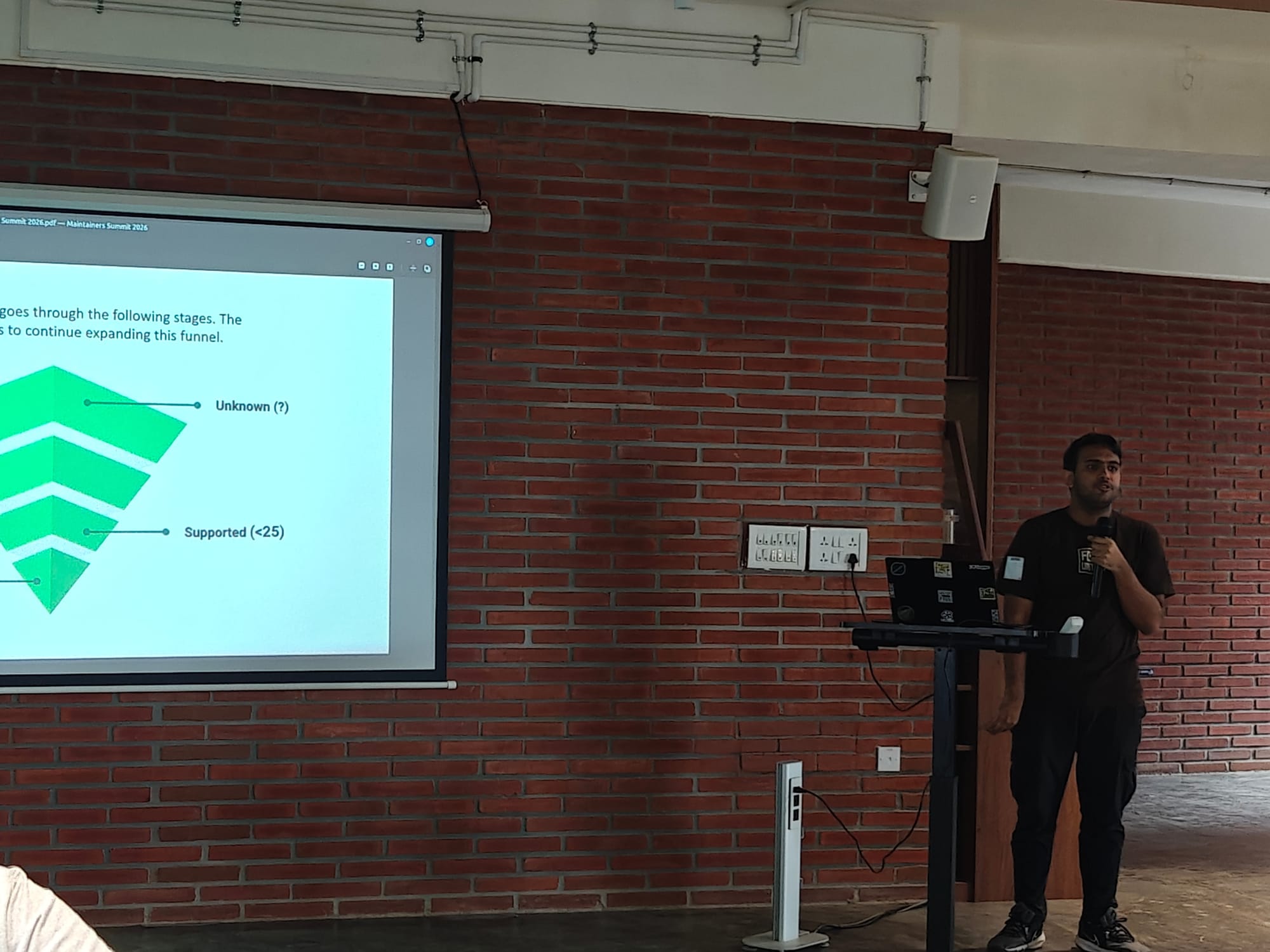
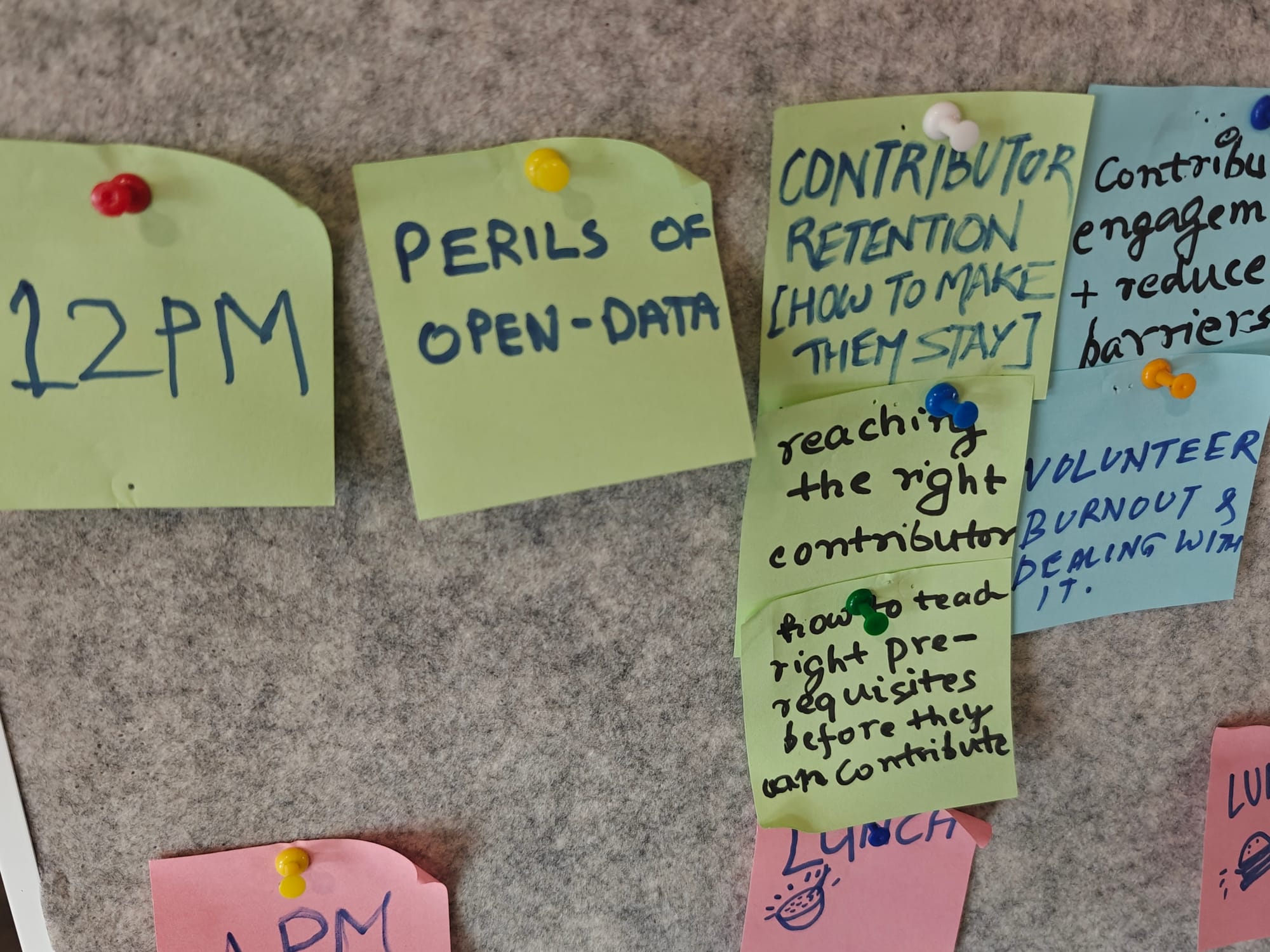
Ansh kicked off the unconference-styled Maintainer Summit's event proceedings with his opening note as we gathered at the whiteboard with our sticky notes to propose things that we wanted to discuss. We had varying degrees of success with the instruments like the sticky notes and markers, but it was hilarious to see just how many maintainers it took to redo the entire board with thumbtacks and a stick board. After proposing Contributor Retention in FOSS Communities, I decided to hang back and help out the fellow organizers. In our passing chats, I could not help but notice a healthy skepticism about using generative tooling along with an overriding enthusiasm for where the technology was headed. I, however, did find myself being psychologically alienated from chats that were bordering on virtue signaling about the general utilization of artificial intelligence-based technologies.
In the times when conversations on artificial intelligence were just unavoidable, I wanted to spend more effort exploring how the technology could be evolved more instead of debating its usage prescriptions. I loved just how the event attendees were a healthy mix of technical individuals and non-technical enthusiasts, both of them desiring to understand the core requirements of the other persona. For the first part, I decided to join the contemporary Git Hosting discussion chaired by the Tangled Project contributing maintainers, along with Veer Kumar and Gaurav, who had arrived at the event venue by then. It felt great to meet up with them at yet another APAC conference, along with Rajan, Deepesh and Shivraj, after our last meetings at DevConf.IN 2026 and FOSSAsia 2026, especially with Rajan also standing for the FOSSUnited Organization governing body elections at that time.
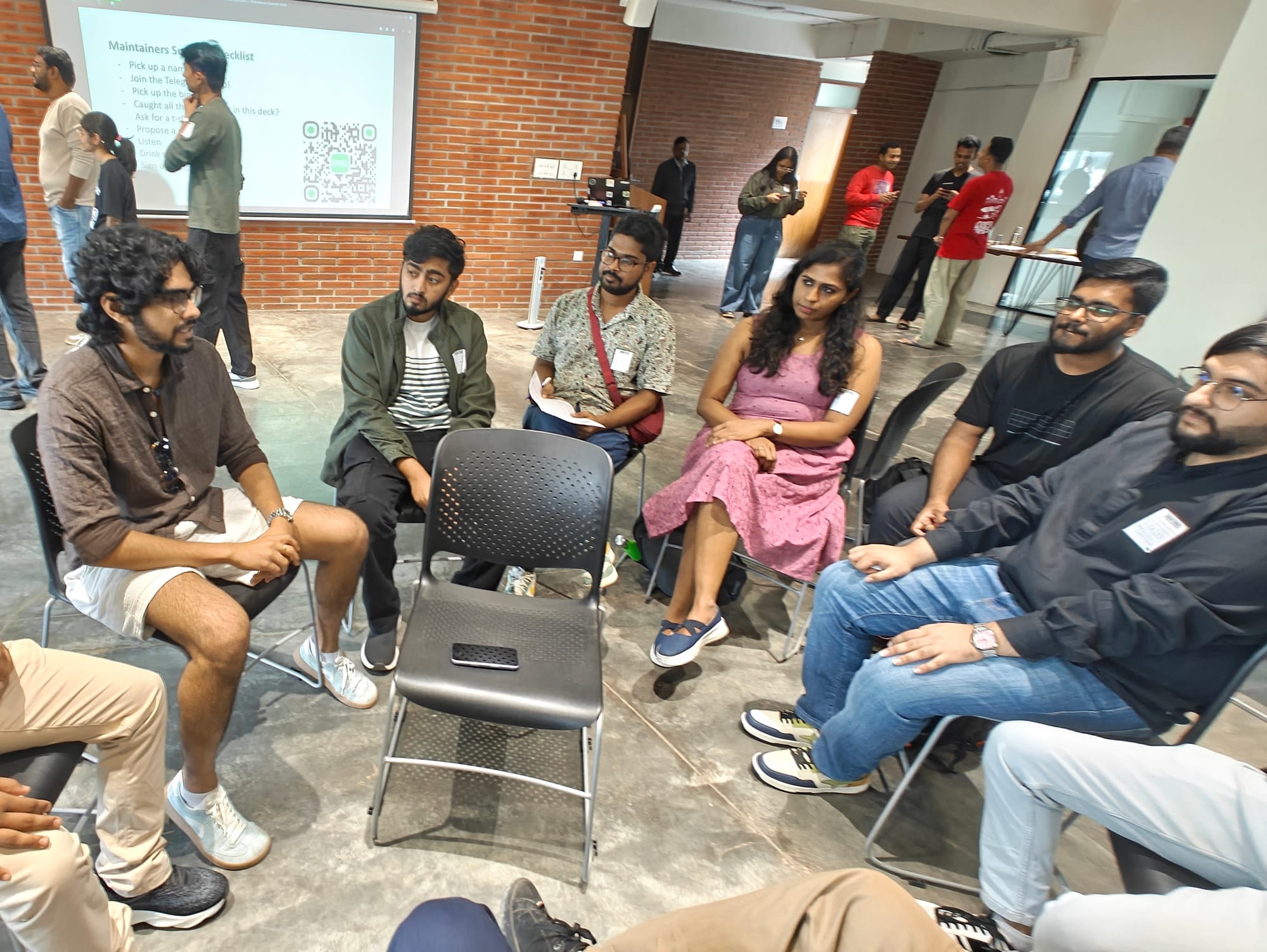
Joining in the maintainer discussions around semantic diffs in various Git hosting services and the general need for workflow evolution, I was genuinely surprised to see just how other maintainers faced the same problems that the Fedora Project had been facing for many years. We passed around a smartphone (to act as a mic) in our small groups as we took turns with what we had to say. As the review system had more or less remained the same for a decade now, I stressed how crucial it had become for the various Git hosting services to use generative tooling to provide semantic diffs in order to help streamline collaboration among maintainers and contributors. We reflected upon and agreed on how the wider accessibility of generative tooling had already made it increasingly difficult for fellow maintainers to review large volumes of codebase changes within reasonable turnaround times.
As time passed by, I was surprised to see just how much my proposed topic on Contributor Retention in FOSS Communities amassed supporting sticky notes. All the support my topic ended up getting moved us from a corner area to the center of the conference. Since it was scheduled for 1200pm Indian Standard Time, Rajan and I briefly joined the discussion on India's Digital Personal Data Protection Act and how it compared with Europe's General Data Protection Regulation Act. Apart from the comparisons, we also delved deeper into the maintainer's responsibilities with data protection and how the policy required general awareness for effective enforcement. Touching on the related topics of Europe's Cyber Resilience Act and the United States' Federal Risk and Authorization Management Program, we also distinguished between the roles of software authors and service administrators.
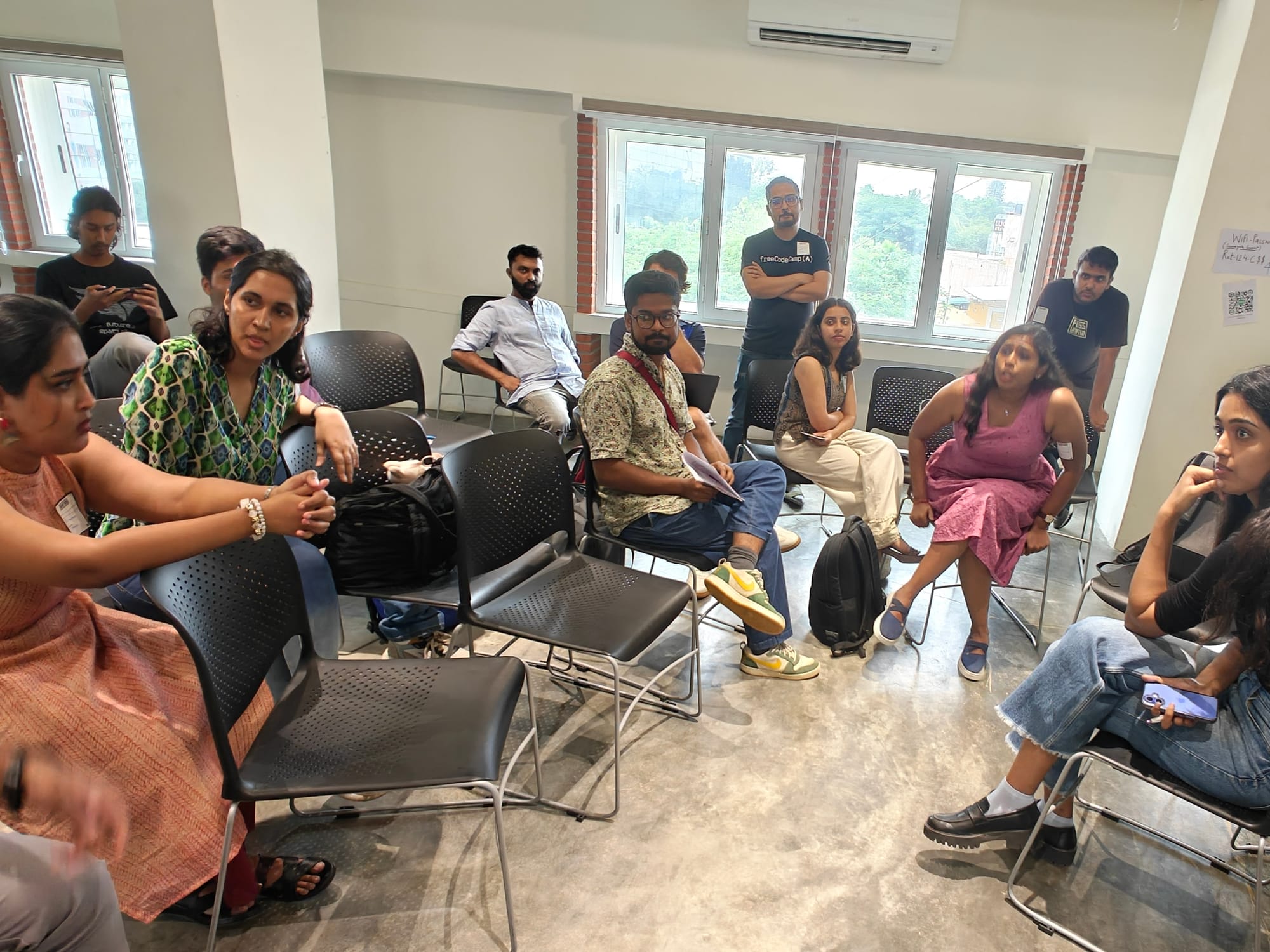
Exploring the frequent Aadhaar data leaks, we reflected on just how important it is for citizens to hold the policymakers accountable for these. While a CRA analogue for India would take a while to come into being, we discussed the best practices for FOSS maintainers to ensure preliminary data safety at their ends on an architectural level. Various case studies were brought up where data security and policy validation were seen as a chore rather than a fundamental responsibility—an observation that I vocally protested about, as a similar attitude towards privacy is what empowers bad actors to discover loopholes in a security policy. Finishing off with this discussion paved the way for the one added by me, and I soon found myself arranging the chairs while preparing for the attendees to arrive. Even when we started off with just five folks, we quickly ballooned to over twenty in no time.
With almost one-third of the unconference population at our discussion, I started off the discussion at around 1215pm Indian Standard Time. We went around the attendees—both technical and managerial in nature—to explore their onboarding experiences from their communities. I was interested to know how the interactions with first-time newcoming contributors went and what made them feel like staying back in a community after their first contribution activity was completed. Gaurav gracefully allowed his iPhone to be used as a mic, and amidst various experiences, I shared a demo of how we incentivized contributions in the Fedora Project with the use of the Fedora Badges platform. As a solution that scaled pretty well across various-sized FOSS communities, they appreciated how this solution could help immensely when shipping swag or attending events could be very difficult.
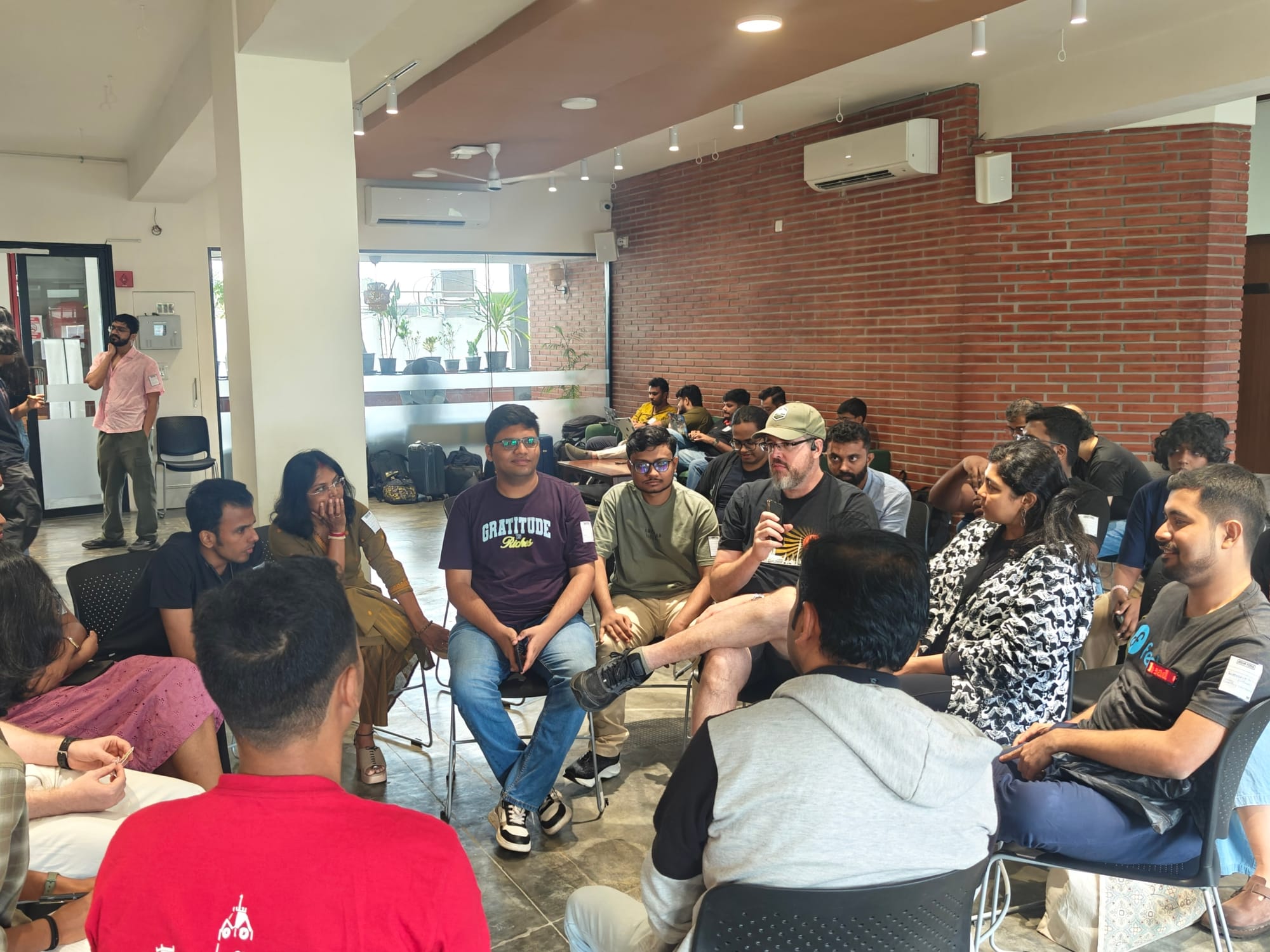
I appreciated how grounded the conversation was, with people realizing that most of the time, people simply appreciate it if their activities are reviewed in time and not left in a metaphoric limbo. While artificial intelligence-based generative tools ensured that the entry barrier was lowered, to the point that even bad actors went on with spamming activities, we also reflected on just how it was hurting the fellow maintainers. Even Ansh could not help joining in on the chat with his experiences while we were waiting for lunch, and at around 0115pm Indian Standard Time, we were finally done with the first half of the day. Joining a queue a little later with my Red Hat friends, I got myself some plain and simple Indian meal with chapatis, pulses, rice, vegetables and sweets. I loved how the healthy lunch represented the Indian hospitality of the unconference event, much akin to FOSSAsia 2026's food.
Hanging out with the likes of Darsh Shah and Shrirang Kahale during lunch, Deepesh showcased his solar-powered self-hosting homelab. We were pleasantly surprised to learn how Shrirang ran eight GNU/Linux mirrors across the country, all while being in his second year of engineering study. With the Red Hat friends leaving at around 0230pm Indian Standard Time after the mealtime discussions, I hung back to see which chats I wanted to be a part of. After briefly joining the one run by the FOSS maintainers from the Wikimedia Foundation, I had a fairly good and engaging discussion around the usage of artificial intelligence for the starter template before ensuring a human review. My analogue to the healthy skepticism was to utilize generative tooling to fill metaphoric potholes on a figurative road created by humans, and avoid doing things the other way around, if possible.
Plagued by the experiences of LLMs basing their output on citations and resources that most likely do not exist, we reflected on the potential stress on reviewers using human time and effort on them. Observing the growing virtue-signaling around artificial intelligence technologies again, I silently resigned myself to calling it a day at around 0400pm Indian Standard Time. Shrirang and I had some Samosas, and after bidding farewell to Poruri Sai Rahul and Ansh, we decided to depart on an Uber ride waiting for us. As much as I wanted to stay back until the evening for the full-course Maintainer Summit event experience, I knew I had other important things to take care of. Not only did I have to check into the hotel after collecting my luggage from the reception, but I also had to prepare for the first day of IndiaFOSS 2026 to represent the Fedora Project alongside our fellow Red Hat associates.